Finding the best dedicated server with DDoS protection is harder than it should be, almost every host claims DDoS protection somewhere on its pricing page. What that phrase actually means varies enormously: some providers bundle real, always-on mitigation free on every plan, others give you a token free tier and quietly charge extra the moment an attack is big enough to matter, and at least one major name on this list doesn’t include it free at all. Nobody puts that distinction in the headline, it’s buried three clicks deep in a knowledge-base article, if it’s published anywhere.
That gap between marketing copy and actual mitigation capacity is exactly where buyers get burned, you sign up for a DDoS protected dedicated server assuming full coverage, then discover mid-attack that included actually meant a few gigabits, not the enterprise-grade anti-DDoS hosting you pictured. A genuinely effective dedicated server DDoS protection setup depends on three things most reviews skip entirely: whether mitigation is always-on or reactive, whether it covers network-layer floods or application-layer attacks too, and whether the provider will actually tell you the ceiling before you need it. If a full dedicated server is overkill for your traffic, our guide to the best cloud hosting providers in USA covers lighter, more flexible alternatives. And if your servers need to sit in Southeast Asia specifically, our best dedicated server Singapore guide checks exactly which providers include real DDoS mitigation there.
This guide answers all three, for 10 real providers, with sources cited for every number.
What Is a Dedicated Server with DDoS Protection?
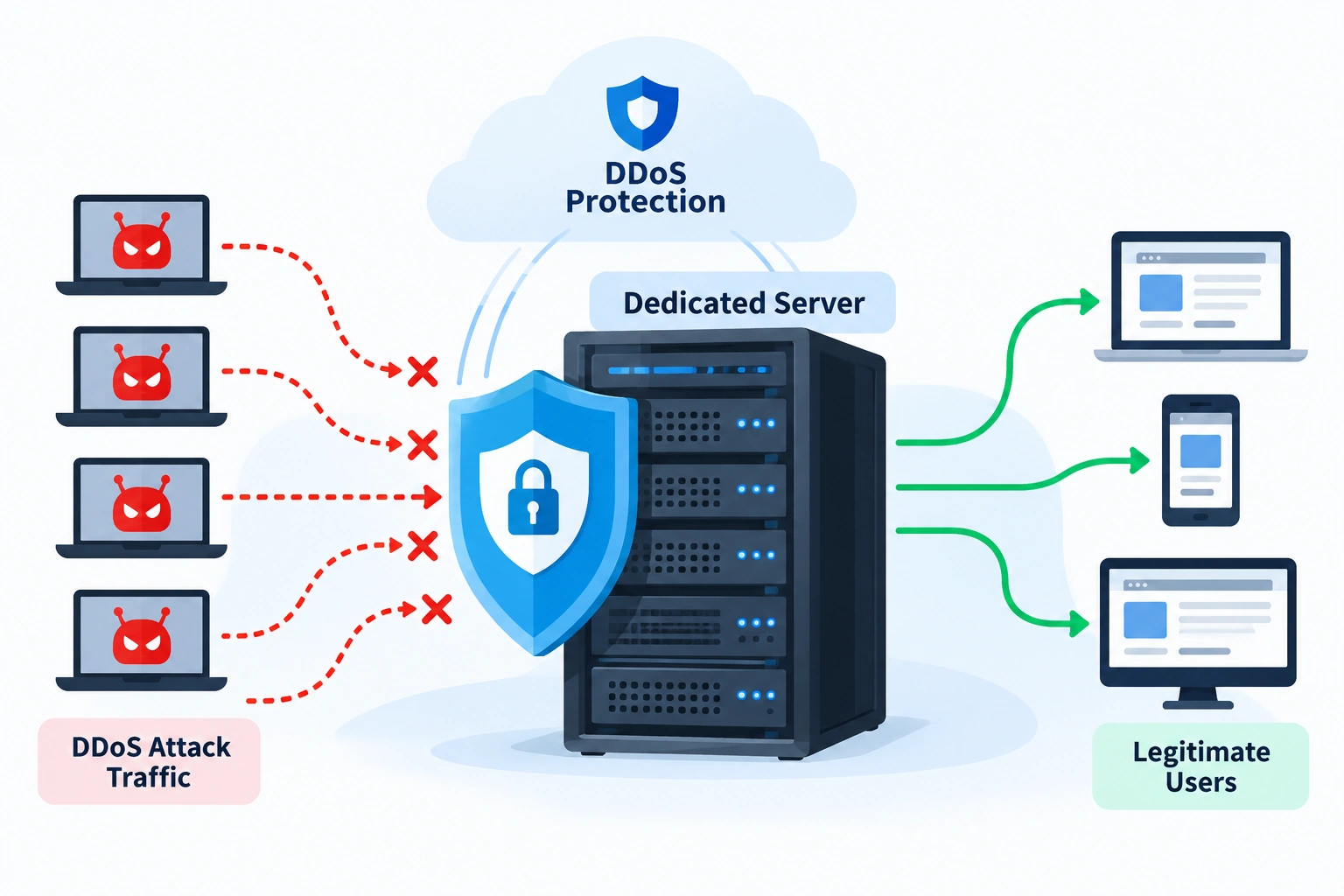
A dedicated server with DDoS protection is a physical server rented entirely to one customer, paired with traffic-filtering technology that detects and blocks distributed denial-of-service attacks before they overwhelm the server’s bandwidth or resources.
That filtering happens one of two ways: at the network edge before malicious traffic ever reaches your server, or through a dedicated scrubbing center the provider routes suspicious traffic to first. The two things that actually separate a good implementation from a marketing checkbox are whether it’s genuinely always-on, rather than only kicking in after you’ve already gone down, and whether the provider actually tells you the real capacity it can absorb.
10 Best Dedicated Servers with DDoS Protection in 2026
⏰ TL;DR
- InterServer: Free DDoS included via InterShield + Path Network, from $59/month
- YouStable: Free always-on DDoS mitigation + hardware firewall, from $77.99/month
- Liquid Web: Free basic tier (up to 2 Gbps), paid Advanced up to 10 Gbps, from $169/month
- QloudHost: Free DDoS included, offshore Netherlands privacy hosting, crypto accepted
- HostDime: DDoS is a paid add-on (Inline/Cloud/Hybrid up to 100 Gbps), servers from $160/month
- phoenixNAP: Free base tier on a 9+ Tbps backbone, from $175/month
- Leaseweb: Free Standard (5 Gbps) + paid Advanced (under 90 sec) on a 10+ Tbps network, from $38/month
- ServerMania: Free base protection + paid higher-capacity tiers, 100% uptime SLA
- Hivelocity: Free FENS protection (blocks 90%+ at the edge) + paid 4-20 Gbps tiers, from $65/month
- OVHcloud: Free, unmetered anti-DDoS (VAC) on every plan, multi-Tbps capacity, from $136/month
1. InterServer — Best Free DDoS Protection with a Price-Lock Guarantee

InterServer bundles DDoS protection free on every dedicated server, no paid tier to unlock better coverage. It runs its own in-house InterShield Security Suite, which applies attack signatures learned from one attack across its entire network, plus a stated infrastructure partnership with Path Network for network-level mitigation, and an optional Cloudflare CDN layer if you want application-layer coverage on top.
InterServer doesn’t publish a specific mitigation capacity in Gbps or Tbps, worth knowing upfront rather than assuming a number that isn’t actually published anywhere. What it does publish clearly is a price-lock guarantee, your renewal rate never increases, a genuine rarity in dedicated hosting.
Founded in 1999 and still run by its original founders, InterServer operates bare-metal-only facilities in Secaucus, New Jersey and Los Angeles.
Key Features
- Free DDoS Protection Included: No paid tier required, InterShield Security Suite plus Path Network partnership cover every dedicated server by default.
- Price-Lock Guarantee: Your rate never increases at renewal, a rare commitment in an industry known for renewal-price surprises.
- Network-Wide Learning: Attack signatures identified on one customer’s server are applied network-wide, protecting others before the same attack repeats.
- Optional Cloudflare Layer: Add application-layer (L7) protection on top of the included network-level coverage if your workload needs it.
- 25+ Years in Business: Founded in 1999 and still owned and operated by its original founders, a long track record in bare-metal hosting.
- US-Based Bare Metal: Facilities in Secaucus, New Jersey and Los Angeles, both fully bare-metal rather than virtualized.
Pricing
- Entry dedicated plans: From roughly $59-$79/month, DDoS protection included at no extra cost.
- Flagship Buy It Now tier: AMD Ryzen, 12-core/64GB configuration around $149/month.
Pros & Cons
| Pros | Cons |
|---|---|
| DDoS protection is genuinely free on every plan, no upsell | No published mitigation capacity number to compare against competitors |
| Price-lock guarantee protects against renewal-rate increases | Only two US data center locations |
At a Glance
- DDoS Protection: Free, included on every plan
- Starting Price: ~$59/month
- Best for: Buyers who want free DDoS coverage plus a genuine renewal-price guarantee.
2. YouStable — Best for Always-On Protection with a Hardware Firewall

YouStable includes DDoS mitigation and a dedicated hardware firewall on its dedicated servers, filtering malicious traffic before it ever reaches the applications running on the box, positioned as an always-on layer rather than something that only activates once an attack is already underway.
Its cheapest current dedicated plan, an E3-1230v3 (4 cores, 32GB DDR4 RAM, 480GB SSD, 10TB bandwidth at 1Gbps), runs $77.99/month on annual billing, down from a regular rate of $91.99/month. Like most providers on this list, YouStable doesn’t publish a specific Gbps or Tbps mitigation capacity figure.
Founded in 2015 and headquartered in Lucknow, India, it operates data centers across India, the US, and the Netherlands, giving it a genuinely international footprint for a company its age.
Key Features
- Always-On DDoS Mitigation: Filters malicious traffic before it reaches your applications, rather than reacting only after an attack starts.
- Dedicated Hardware Firewall: A physical firewall layer included alongside DDoS mitigation, not just a software-only filter.
- Free Migration: Moving an existing server over doesn’t cost extra, removing a common switching-cost barrier.
- AMD EPYC and Intel Xeon Options: A real choice of modern CPU platforms with ECC RAM and NVMe RAID across tiers.
- Full Root and IPMI Access: Complete administrative control plus out-of-band IPMI/iLO/KVM for hands-on management.
- Three-Region Data Centers: India, US, and Netherlands locations, useful for regional latency or GDPR-conscious deployments.
Pricing
- Starting price: $77.99/month (annual billing) for an E3-1230v3, 32GB RAM, 480GB SSD, 10TB/1Gbps configuration.
- Regular (non-discounted) rate: $91.99/month for the same configuration.
Pros & Cons
| Pros | Cons |
|---|---|
| Always-on DDoS mitigation plus a hardware firewall included standard | No published mitigation capacity figure, same gap as most competitors here |
| Genuine multi-region footprint (India, US, Netherlands) for a company its age | Newer track record than decades-old names like InterServer or OVHcloud |
At a Glance
- DDoS Protection: Free, included standard
- Starting Price: $77.99/month
- Best for: Buyers who want always-on protection plus a real hardware firewall layer at a competitive entry price.
3. Liquid Web — Best Award-Winning Tiered DDoS Protection

Liquid Web runs a genuinely tiered model: a free basic DDoS tier is included with every server plan, mitigating roughly 250 Mbps to 2 Gbps of attack traffic, real-time border-layer monitoring with threat analytics built into the infrastructure. For anything bigger, Advanced and Premium tiers are paid add-ons that extend Layer 4 attack defense up to 10 Gbps.
That tiered honesty is worth noting explicitly: Liquid Web doesn’t claim its free tier handles everything, it tells you where the free coverage ends and where you’d need to pay for more. It won HostingAdvice’s 2025 Web Developer Choice Award for Best DDoS Protection Hosting, on top of a separate Best Dedicated Hosting Provider award the same year.
Founded in 1997 and headquartered in Lansing, Michigan, Liquid Web operates its own wholly-owned data centers rather than leasing space from a third party.
Key Features
- Free Basic DDoS Tier: Included on every plan, mitigating an estimated 250 Mbps to 2 Gbps of attack traffic at no extra charge.
- Paid Advanced/Premium Tiers: Extend Layer 4 defense up to 10 Gbps for larger, more sophisticated attacks than the free tier covers.
- 2025 Industry Award Winner: Won HostingAdvice’s Best DDoS Protection Hosting award, an independent third-party recognition, not self-claimed marketing.
- Real-Time Border Monitoring: Traffic analytics and threat detection built directly into the network infrastructure, not a bolted-on afterthought.
- Fully Managed Support: Liquid Web is known specifically for hands-on managed support, useful if you don’t want to self-administer DDoS response.
- Wholly-Owned Data Centers: Operates its own facilities in Lansing, Michigan rather than leasing third-party space.
Pricing
- Starting price: ~$169/month for the cheapest dedicated server tier, free basic DDoS protection included.
- Advanced/Premium DDoS add-ons: Priced separately on top of the base server cost for coverage up to 10 Gbps.
Pros & Cons
| Pros | Cons |
|---|---|
| Independently award-winning DDoS protection, not just self-marketed | Highest entry price on this list at ~$169/month |
| Clear, published Gbps figures for both free and paid tiers | Real protection against larger attacks requires paying extra |
At a Glance
- DDoS Protection: Free basic tier (250 Mbps-2 Gbps) + paid Advanced/Premium up to 10 Gbps
- Starting Price: ~$169/month
- Best for: Buyers who want independently-verified DDoS protection and are willing to pay for higher-capacity coverage.
4. QloudHost — Best for Offshore Privacy with Free DDoS Included

QloudHost bundles DDoS protection free with its dedicated servers, running from a Tier-III data center in the Netherlands rather than the US, a genuine consideration for buyers specifically prioritizing offshore jurisdiction alongside attack protection. NVMe storage and a 99.95% uptime SLA are standard across its dedicated lineup.
Like most of the providers on this list, QloudHost doesn’t publish a specific mitigation capacity number, treat the included claim as standard-tier protection rather than an enterprise-scale guarantee. It also accepts Bitcoin and USDT directly at checkout, unusual for a dedicated server provider and consistent with its broader privacy-first positioning.
QloudHost is a newer name than most others here, which shows up in a thinner independent review footprint, but the offshore-plus-DDoS-plus-crypto combination is a genuinely specific niche few competitors on this list target directly.
Key Features
- Free DDoS Protection Included: Bundled standard on dedicated server plans, no separate add-on cost mentioned.
- Netherlands Tier-III Data Center: Offshore jurisdiction under Dutch and EU law, distinct from US-based competitors.
- NVMe Storage Standard: Applied across the dedicated server lineup, not reserved for higher-priced tiers only.
- 99.95% Uptime SLA: A concrete, published uptime commitment rather than a vague high-availability claim.
- Bitcoin and USDT Accepted: Real cryptocurrency payment at checkout, not a manual arrangement, unusual for dedicated hosting.
- DMCA-Ignored Positioning: Built specifically for privacy-first use cases alongside attack protection.
Pricing
- Dedicated server plans: Higher-tier configurations run around $349/month; confirm current entry-tier pricing directly, as exact lower-tier figures weren’t published at time of writing.
- DDoS protection: Included at no extra cost.
Pros & Cons
| Pros | Cons |
|---|---|
| Genuine offshore jurisdiction combined with free DDoS protection | No published mitigation capacity figure |
| Real crypto payment support, not a manual workaround | Thinner independent review history than established US competitors |
At a Glance
- DDoS Protection: Free, included standard
- Starting Price: ~$349/month (higher-tier configuration)
- Best for: Buyers who specifically want offshore, DMCA-ignored infrastructure alongside free DDoS protection and crypto payment.
5. HostDime — Most Technically Transparent Paid DDoS Add-On

HostDime is the one provider on this list where DDoS protection is not bundled free at all, it’s a paid add-on available only to dedicated server and colocation clients. What sets it apart is transparency: HostDime publishes three named modes with real capacity figures, Inline (on-premises NETSCOUT PeakFlow SP hardware, up to 10 Gbps), Cloud Scrubbing (via GRE tunnels, up to 100 Gbps), and a Hybrid option combining both.
That’s a real, named enterprise technology partner (NETSCOUT, using its ATLAS threat intelligence) and a clearly published capacity ceiling, more technical detail than most free-tier competitors disclose about their own bundled protection. Inline pricing starts around $75/month per server; Cloud/Hybrid starts around $100/month per /29 block (5 IPs), with overage billed at $0.50/Mbps beyond your tier.
Founded in 2003 in Orlando, Florida, HostDime expanded internationally from 2006 onward, with facilities spanning Brazil, the Netherlands, and Hong Kong.
Key Features
- Named Enterprise Technology: Uses NETSCOUT PeakFlow SP hardware and ATLAS threat intelligence, a specific, verifiable technology stack, not vague marketing.
- Three Published Modes: Inline (10 Gbps), Cloud Scrubbing (100 Gbps), and Hybrid, each with a clearly stated capacity ceiling.
- Covers L3/L4 and L7: Addresses both volumetric network-layer attacks and application-layer attacks per HostDime’s own published materials.
- Clear Overage Pricing: $0.50/Mbps beyond your tier, a transparent rate rather than a vague contact-sales answer.
- 22+ Years in Business: Founded 2003 in Orlando, expanded internationally to Brazil, the Netherlands, and Hong Kong.
- Colocation Support: DDoS add-ons are also available to colocation clients, not just dedicated server renters.
Pricing
- Dedicated servers: From ~$160/month, DDoS protection NOT included.
- Inline DDoS add-on: From ~$75/month per server (up to 10 Gbps).
- Cloud/Hybrid DDoS add-on: From ~$100/month per /29 block (up to 100 Gbps), overage at $0.50/Mbps.
Pros & Cons
| Pros | Cons |
|---|---|
| Most technically transparent published DDoS specs of any provider here | Not included free, a genuine added monthly cost on top of the server itself |
| Real named enterprise technology (NETSCOUT), not vague in-house branding | Total monthly cost (server + DDoS add-on) can exceed some all-inclusive competitors |
At a Glance
- DDoS Protection: Paid add-on only, from ~$75/month (not included free)
- Starting Price: ~$160/month (server) + DDoS add-on
- Best for: Buyers who want precise, published DDoS specs and are willing to pay separately for exactly the capacity they need.
6. phoenixNAP — Best for a Massive Backbone with API-Driven Provisioning

phoenixNAP includes DDoS protection free on its base dedicated server tier, backed by what it describes as a global, continuously-scanning, multi-layered detection system. The company separately advertises a 9+ Tbps network backbone with multiple 10 Gbps DDoS-protected transit connections, a genuinely large-scale infrastructure claim, though the exact free-tier mitigation ceiling per server isn’t clearly published on phoenixNAP’s own DDoS page.
What distinguishes phoenixNAP from most names on this list is its API, CLI, and Terraform-driven bare metal provisioning, positioning it more toward developers and enterprises automating infrastructure than toward a simple pick-a-plan-and-checkout buyer.
Founded in 2009 and headquartered in Phoenix, Arizona, it operates seven or more global data center locations. It also runs a separate GPU dedicated server lineup with its own DDoS specs, covered in our GPU dedicated servers comparison.
Key Features
- Free Base DDoS Protection: Included on standard dedicated server plans without requiring a paid upgrade.
- 9+ Tbps Network Backbone: A large, publicly stated network capacity figure, among the biggest claimed by any provider on this list.
- API, CLI, and Terraform Support: Genuine infrastructure-as-code provisioning, not just a web dashboard.
- Continuously-Scanning Detection: Automated, always-on traffic monitoring rather than manual or on-demand activation.
- 7+ Global Data Centers: A genuinely international footprint for enterprise and multi-region deployments.
- 16 Years in Business: Founded 2009 in Phoenix, Arizona, with an enterprise-IaaS-leaning reputation.
Pricing
- Starting price: ~$175/month for the cheapest dedicated server tier, base DDoS protection included.
Pros & Cons
| Pros | Cons |
|---|---|
| Large, publicly stated 9+ Tbps backbone capacity | Exact per-server free-tier mitigation ceiling isn’t clearly published |
| Genuine infrastructure-as-code provisioning (API/CLI/Terraform) | More enterprise-leaning pricing and positioning than budget alternatives |
At a Glance
- DDoS Protection: Free base tier included
- Starting Price: ~$175/month
- Best for: Developers and enterprises wanting API-driven provisioning on a large-capacity network.
7. Leaseweb — Best Published Mitigation-Time SLA

Leaseweb includes Standard DDoS IP Protection free on every dedicated server, handling volumetric attacks up to 5 Gbps with mitigation kicking in within 2-3 minutes and automated email alerts. An Advanced tier is available as a paid per-IP upgrade, described as always-on in-line mitigation covering any attack type, with mitigation time under 90 seconds, a genuinely specific, published SLA that most competitors don’t commit to in writing.
Leaseweb’s overall network capacity exceeds 10 Tbps, and at least one published case study confirms its DDoS scrubbing stack uses A10 Networks Thunder TPS technology, a named, verifiable third-party vendor rather than vague in-house branding.
Founded in 1997 in the Netherlands and headquartered in Amsterdam since 2007, Leaseweb operates roughly 20-28 data centers globally.
Key Features
- Free Standard DDoS Protection: Up to 5 Gbps of volumetric attack mitigation included on every dedicated server at no extra cost.
- Paid Advanced Tier: Always-on in-line mitigation for any attack type, with mitigation time under 90 seconds, a rare published SLA.
- Named Third-Party Technology: Confirmed use of A10 Networks Thunder TPS in its scrubbing infrastructure via a public case study.
- 10+ Tbps Network Capacity: A large, stated overall network figure backing its DDoS mitigation claims.
- Automated Alerting: Email notifications when the standard tier detects and mitigates an attack, keeping you informed without manual monitoring.
- 28 Years in Business: Founded 1997, headquartered in Amsterdam since 2007, with 20-28 global data centers.
Pricing
- Cheapest dedicated tier: ~$38-$40/month (4 CPU/8GB RAM/2TB HDD, 12-month term), Standard DDoS protection included free.
- Higher-spec Xeon configurations: $150-$180+/month depending on region and specs.
- Advanced DDoS upgrade: Priced per IP address as a separate add-on.
Pros & Cons
| Pros | Cons |
|---|---|
| One of the lowest entry prices on this list at ~$38/month | Free tier caps at 5 Gbps, real attacks often exceed that |
| Rare, specific published mitigation-time SLA (under 90 sec on Advanced) | Advanced tier’s exact pricing requires a quote per IP |
At a Glance
- DDoS Protection: Free Standard (5 Gbps) + paid Advanced (under 90 sec, any attack type)
- Starting Price: ~$38/month
- Best for: Budget-conscious buyers who still want a genuine, published mitigation-time commitment available as an upgrade.
8. ServerMania — Best 100% Network Uptime SLA

ServerMania includes a base level of DDoS protection free by default, with higher-capacity protection available as a paid upgrade for larger attacks. Published mitigation figures are genuinely inconsistent across ServerMania’s own materials and third-party sources over the years, anywhere from 1 Gbps free with 100 Gbps+ paid, to a flat 20 Gbps free tier, so treat any specific number you see elsewhere with caution and confirm current figures directly before committing to a plan.
What is consistently published is a 100% network uptime SLA, a bold, specific commitment that ServerMania has marketed alongside its no-charge DDoS protection messaging since as early as 2015.
Founded in 2002 as B2 Net Solutions and rebranded ServerMania in 2012, it’s headquartered in the Toronto area of Ontario, Canada.
Key Features
- Free Base DDoS Protection: Included by default, with paid upgrades available for higher-capacity coverage against larger attacks.
- 100% Network Uptime SLA: A specific, published guarantee rather than a vague high-availability claim.
- Long-Standing No-Charge Messaging: Has marketed free DDoS protection as a differentiator since at least 2015.
- 23 Years in Business: Founded 2002 as B2 Net Solutions, rebranded ServerMania in 2012.
- Configurator-Based Pricing: Build a custom configuration rather than being limited to a few fixed tiers.
- Canadian Headquarters: Based in Stoney Creek, Ontario, in the Toronto metro area.
Pricing
- Entry dedicated tier: Around $50/month per general marketing copy, though actual pricing is largely quote/configurator-based.
- Higher-end configuration: A dual Xeon Silver setup runs roughly $519/month.
Pros & Cons
| Pros | Cons |
|---|---|
| Specific, published 100% network uptime SLA | DDoS mitigation Gbps figures are inconsistent across sources, confirm directly |
| Long track record of “no charge” DDoS messaging since 2015 | Pricing is largely quote-based rather than published fixed rates |
At a Glance
- DDoS Protection: Free base tier + paid higher-capacity upgrades
- Starting Price: ~$50/month
- Best for: Buyers who want a specific 100% uptime SLA and are comfortable configuring a custom quote.
9. Hivelocity — Best Named In-House Edge Filtering System

Hivelocity includes DDoS protection free by default on every bandwidth-enabled service, via its proprietary FENS network-protection system, which it describes as blocking over 90% of malicious traffic at the network edge before it ever reaches your server. For workloads that need more, enterprise-grade paid tiers range from roughly 4 Gbps to 20 Gbps of filtering capacity across three tiers, plus an optional full-packet data-scrubbing add-on.
That’s a specifically named in-house system with a quantified claim, one of the more concrete how-it-actually-works explanations among the budget and mid-tier providers on this list. Dedicated port speeds range from 1 to 40 Gbps depending on plan.
Founded around 2001-2002 in Tampa, Florida, Hivelocity was acquired by ColoHouse in April 2024 and remains headquartered in Tampa.
Key Features
- Free FENS Protection: Blocks over 90% of malicious traffic at the network edge by default, included on every bandwidth-enabled service.
- Paid Enterprise Tiers: Three tiers ranging from 4 Gbps to 20 Gbps of filtering capacity for larger attacks than the free tier handles.
- Optional Full-Packet Scrubbing: A dedicated add-on for complete packet validation beyond standard edge filtering.
- 1-40 Gbps Port Speeds: A wide range of dedicated port options depending on plan tier.
- Low Entry Pricing: Cheapest dedicated server starts at $65/month, with promo pricing occasionally reaching as low as ~$40/month.
- Backed by ColoHouse: Acquired in April 2024, adding a larger parent company’s resources behind Hivelocity’s existing Tampa-based infrastructure.
Pricing
- Starting price: $65/month (Kaby Lake E3-1230 v6, 32GB RAM, 480GB SSD, 20TB bandwidth, Tampa), basic DDoS protection included free.
- Enterprise DDoS add-on tiers: Priced separately for 4-20 Gbps of additional filtering capacity.
Pros & Cons
| Pros | Cons |
|---|---|
| Named, quantified in-house filtering system (blocks 90%+ at the edge) | Recent ownership change (ColoHouse, 2024) adds some transition uncertainty |
| Low entry price with real bandwidth included (20TB) | Enterprise-tier DDoS capacity (20 Gbps) is lower than HostDime’s or Leaseweb’s paid ceilings |
At a Glance
- DDoS Protection: Free FENS base tier + paid 4-20 Gbps enterprise tiers
- Starting Price: $65/month
- Best for: Buyers who want a named, quantified free filtering system at a low entry price.
10. OVHcloud — Best Free, Unmetered DDoS Protection on Every Plan

OVHcloud includes DDoS protection free and unmetered on every dedicated server, including its cheapest tier, no exceptions by attack size or duration. It runs a proprietary anti-DDoS system called VAC (Vacuum), developed in-house over more than 15 years, combining deep packet inspection with machine learning for real-time traffic classification.
Published capacity figures vary across OVHcloud’s own materials and reporting dates, ranging from roughly 15 Tbps to over 20 Tbps depending on the source, with one documented real-world mitigation reaching approximately 2.5 Tbps and 840 million packets per second. Rather than quote one precise number as if it were fixed, it’s more accurate to say OVHcloud publishes multi-Tbps mitigation capacity that has scaled upward over time.
Founded November 2, 1999 by Octave Klaba in Roubaix, France, and still family-run, OVHcloud today operates roughly 43 data centers across four continents, serving over 1.6 million customers in 140+ countries, one of the largest and longest-running names on this entire list. For broader hardware and pricing options beyond DDoS protection specifically, our USA dedicated server comparison covers OVHcloud’s full RISE lineup alongside nine other providers.
Key Features
- Free, Unmetered DDoS Protection: Included on every dedicated server regardless of tier, with no extra charge regardless of attack size or duration.
- Proprietary VAC Anti-DDoS System: An in-house system developed over 15+ years, not a third-party service or a recent acquisition.
- Multi-Tbps Mitigation Capacity: Published figures range from roughly 15 to over 20 Tbps depending on source and date, among the largest on this list.
- Documented Real-World Mitigation: A confirmed attack of approximately 2.5 Tbps and 840 million packets per second was successfully mitigated.
- 43 Global Data Centers: Spanning four continents, one of the largest infrastructure footprints of any provider covered here.
- 26 Years in Business: Founded in 1999, still family-run, serving over 1.6 million customers in 140+ countries today.
Pricing
- Starting price: ~$136/month for the current Advance-1 tier (AMD EPYC 4244P, 32-192GB RAM, 1-5 Gbps public bandwidth), plus a one-time setup fee of similar amount.
- Older/ECO-range hardware: Some sources cite an overall starting figure near $96.62/month.
- Anti-DDoS protection: Bundled at no extra cost regardless of tier.
Pros & Cons
| Pros | Cons |
|---|---|
| Free, unmetered protection on every tier, no exceptions | One-time setup fee adds to the effective first-month cost |
| Largest, longest-proven in-house DDoS system of any provider here | Published capacity figures vary by source rather than one fixed number |
At a Glance
- DDoS Protection: Free, unmetered, included on every plan
- Starting Price: ~$136/month
- Best for: Buyers who want the largest, most established free DDoS infrastructure with no attack-size caveats.
Free vs. Paid DDoS Protection: Which Providers Give You What
This is the single most important distinction in this entire guide, and it’s exactly where marketing pages get vague. Here’s precisely which providers include real protection free at the hardware/network level, and which only get you started free before charging for the capacity that actually matters during a real attack.
| Provider | Free Tier | Paid Tier |
|---|---|---|
| InterServer | Full protection included, no paid tier needed | Optional Cloudflare CDN layer for L7 |
| YouStable | Full protection included, no paid tier needed | None published |
| Liquid Web | Basic, up to ~2 Gbps | Advanced/Premium, up to 10 Gbps |
| HostDime | None, not bundled free | Inline (10 Gbps) / Cloud (100 Gbps) / Hybrid, from ~$75/mo |
| QloudHost | Full protection included, no paid tier needed | None published |
| phoenixNAP | Base tier included on 9+ Tbps backbone | Not clearly published as a separate tier |
| Leaseweb | Standard, up to 5 Gbps, 2-3 min mitigation | Advanced, any attack type, under 90 sec |
| ServerMania | Base tier included (exact Gbps unclear) | Higher-capacity upgrade available |
| Hivelocity | FENS, blocks 90%+ at the edge | Enterprise tiers, 4-20 Gbps |
| OVHcloud | Full, unmetered, multi-Tbps, no paid tier needed | N/A, already unlimited |
Four providers, InterServer, YouStable, QloudHost, and OVHcloud, genuinely need nothing extra: what’s free is the real protection, not a teaser. HostDime sits at the other end, real protection but strictly paid. The remaining five run a tiered model, free covers smaller, more common attacks, and you pay when an attack is large enough to actually threaten uptime.
What DDoS Protection Actually Does (And What It Doesn’t)
DDoS protection works by sitting between the public internet and your server, analyzing incoming traffic patterns, and dropping or redirecting anything that looks like an attack before it consumes your server’s bandwidth or resources. There are two broad approaches worth understanding, because they cover different things.
- Network-layer (L3/L4) protection defends against volumetric floods, overwhelming raw bandwidth or connection tables with junk traffic. This is what most free tiers on this list actually cover, and it’s genuinely the most common attack type.
- Application-layer (L7) protection defends against attacks that mimic real user requests, harder to distinguish from legitimate traffic, and usually requires a web application firewall (WAF) on top of network-level DDoS mitigation, not instead of it.
What DDoS protection does not do: protect against a data breach, stop a determined attacker from eventually finding an unprotected port or subdomain, or make your server invulnerable during an attack large enough to exceed whatever capacity your provider has actually committed to. Every protected claim has a ceiling, the entire point of this guide is knowing what that ceiling actually is before you need it.
Signs Your Dedicated Server Is Under DDoS Attack
A DDoS attack rarely announces itself outright, it shows up as a cluster of symptoms that look like normal load problems at first, until several hit your server at once.
- Sudden, unexplained traffic spikes that don’t correlate with any marketing push, product launch, or organic growth you’re aware of.
- Site or service becoming slow or completely unreachable despite no recent code deployment, configuration change, or scheduled maintenance.
- An unusual number of connection requests from a narrow range of IP addresses, or conversely, a flood from thousands of different IPs at once.
- Server logs filling up abnormally fast with repeated requests to the same endpoint, often at a rate no real user would generate.
- Network bandwidth usage maxing out even though your actual application traffic hasn’t changed.
- Your hosting provider proactively contacts you about unusual traffic, often the first real signal if your own monitoring isn’t set up to catch it.
Real DDoS Attack Size Benchmarks: What Protection Actually Needs to Handle
Numbers like 20 Gbps or multi-Tbps mean little without context. Here’s what real, documented attacks have actually reached, so you can judge whether a provider’s stated capacity is a meaningful safety margin or barely enough.
| Year | Target | Attack Size | Method |
|---|---|---|---|
| 2017 | Google Cloud | 2.54 Tbps | Spoofed packets sent to 180,000 web servers (disclosed by Google in 2020) |
| 2018 | GitHub | 1.35 Tbps | Memcached amplification, no botnet involved |
| 2020 | Amazon Web Services | 2.3 Tbps | CLDAP reflection attack, sustained over three days |
| 2024 | Cloudflare (mitigated on behalf of a customer) | 3.8 Tbps | Volumetric attack, a new record at the time |
Almost none of the 10 providers in this guide publish a capacity anywhere near these figures, and for the vast majority of dedicated server buyers, that’s genuinely fine, these record-setting attacks targeted some of the largest infrastructure companies in the world, not a typical business site. The point of this table isn’t to scare you into overspending on capacity you’ll never need, it’s to give real scale to the Gbps and Tbps numbers throughout this guide, so a 20 Gbps included claim reads as what it actually is: solid protection against common attacks, not a defense built for an internet-scale event.
Common Mistakes and Myths About DDoS-Protected Dedicated Servers
- Assuming DDoS protection included means unlimited protection. As this guide shows, most included tiers have a real, specific capacity ceiling, some published, some not.
- Confusing network-layer protection with application-layer protection. A server protected against volumetric floods can still go down from an L7 attack if you don’t also have a WAF.
- Not asking about mitigation time. A provider that takes several minutes to detect and respond can still mean real downtime, even with genuine protection in place.
- Assuming a bigger-sounding Tbps number always matters more than your actual risk profile. A small business rarely faces a multi-Tbps attack; matching protection to realistic risk usually matters more than chasing the largest published number.
- Not budgeting for the paid tier upfront. If you’re on a tiered provider, decide before an attack happens whether you’ll pay for the higher tier, not during an active incident.
How to Choose the Right DDoS-Protected Dedicated Server
The best dedicated server with DDoS protection for you depends less on brand recognition and more on matching the specific scenario below to your actual workload.
- Running a small site or low-traffic application: Any of the free-included options (InterServer, YouStable, QloudHost) cover realistic risk without extra cost.
- Running an e-commerce store or anything handling real transactions: Prioritize a published mitigation-time SLA, Leaseweb’s under-90-second Advanced tier is the most specific commitment on this list.
- Running a gaming server or high-value target likely to face large attacks: OVHcloud’s unmetered, multi-Tbps protection removes the will-this-cost-extra question entirely.
- Need precise, contractually specific DDoS terms for a compliance or enterprise requirement: HostDime’s named NETSCOUT technology and published capacity tiers give you the clearest paper trail.
- Prioritizing offshore privacy alongside attack protection: QloudHost is the only provider here built specifically around that combination.
How Much Does a Dedicated Server with DDoS Protection Cost?
Entry-level dedicated servers with DDoS protection genuinely included range from about $38/month (Leaseweb) to $136/month (OVHcloud) among the providers covered here, with most clustering between $60-$80/month for a real, usable configuration. Add a paid DDoS tier on a provider that requires one, and the effective monthly cost can climb by another $75-$100+/month depending on the capacity you need. The honest total-cost comparison isn’t the cheapest server alone, it’s the cheapest server plus whatever DDoS tier actually matches your real risk.
Frequently Asked Questions
Which dedicated server provider has the best free DDoS protection?
OVHcloud offers the strongest free option, unmetered protection on every plan with multi-Tbps capacity and no attack-size caveats. InterServer, YouStable, and QloudHost also include genuinely full protection free, without a paid tier needed for standard use.
Is DDoS protection always included free with a dedicated server?
No. Most providers include a free base tier, but HostDime does not bundle DDoS protection free at all, it’s a paid add-on starting around $75/month. Several others (Liquid Web, Leaseweb, Hivelocity) include a free tier but charge extra once an attack exceeds that tier’s published capacity.
What’s the difference between network-layer and application-layer DDoS protection?
Network-layer (L3/L4) protection defends against volumetric floods overwhelming raw bandwidth, which is what most free DDoS tiers cover. Application-layer (L7) protection defends against attacks disguised as real user traffic, and typically requires a separate web application firewall on top of network-level protection, not instead of it.
How much DDoS mitigation capacity do I actually need?
For most small businesses and personal projects, a few Gbps of network-layer protection, the free tier on most providers here, covers realistic risk. Multi-Tbps capacity like OVHcloud’s matters mainly for high-profile targets: gaming servers, crypto platforms, or businesses that have previously been attacked at scale.
Why don’t some providers publish their DDoS mitigation capacity in Gbps?
Some providers, including InterServer, YouStable, and QloudHost, don’t publish a specific number anywhere in their marketing or documentation. That doesn’t necessarily mean the protection is weak, but it does mean you’re trusting a general claim rather than a verifiable figure, worth factoring into your decision if precise capacity matters for your use case.
Can DDoS protection stop every type of attack?
No single provider’s protection is complete. DDoS mitigation defends against traffic-flood attacks specifically, it doesn’t protect against data breaches, application vulnerabilities, or an attack large enough to exceed whatever capacity ceiling your specific plan actually covers.
How do I know if my dedicated server is under a DDoS attack?
Common signs include sudden unexplained traffic spikes, a site or service becoming slow or unreachable with no recent changes on your end, network bandwidth maxing out despite unchanged application traffic, and server logs filling up with repeated requests to the same endpoint. Some hosts will also proactively contact you about unusual traffic.
How big was the largest DDoS attack ever recorded?
As of 2026, Cloudflare’s mitigation of a 3.8 Tbps attack in October 2024 holds the record. Earlier landmark attacks include a 2.54 Tbps attack on Google Cloud in 2017 (disclosed in 2020), a 2.3 Tbps attack on AWS in 2020, and a 1.35 Tbps memcached-based attack on GitHub in 2018.
Does DDoS protection cost extra on a dedicated server?
It depends entirely on the provider. InterServer, YouStable, QloudHost, and OVHcloud include full protection free on every plan. Liquid Web, Leaseweb, phoenixNAP, ServerMania, and Hivelocity include a free base tier but charge extra for higher-capacity coverage. HostDime is the one provider here where DDoS protection is a paid add-on from the start, not bundled free at all.
Final Verdict
There’s no single best dedicated server with DDoS protection, the right pick depends on whether you need free-and-done coverage, a specific mitigation-time guarantee, or the largest possible capacity ceiling. For most buyers who just want real, no-asterisk free protection, InterServer, YouStable, and QloudHost all deliver that without pushing you toward a paid upgrade.
If your risk profile is genuinely higher, running an e-commerce store, a gaming server, or anything that’s been targeted before, prioritize a provider with a large published backbone and a named, quantified filtering system over one that just claims to be protected with no numbers behind it. A precise, contractually specific DDoS technology stack is worth paying for separately when a compliance requirement demands it, even if that means a higher total monthly cost than an all-inclusive plan.
Whichever you choose, confirm the real mitigation capacity and mitigation time directly with the provider before you need it, not during an actual attack.
In Short, These Are the 10 Best Dedicated Servers with DDoS Protection in 2026
| # | Provider | Starting Price | DDoS Protection | Best For |
|---|---|---|---|---|
| 1 | InterServer | ~$59/month | Free, included | Free protection + price-lock guarantee |
| 2 | YouStable | $77.99/month | Free, included | Always-on mitigation + hardware firewall |
| 3 | Liquid Web | ~$169/month | Free basic + paid up to 10 Gbps | Award-winning tiered protection |
| 4 | QloudHost | ~$349/month | Free, included | Offshore privacy + crypto payment |
| 5 | HostDime | ~$160/month | Paid add-on, up to 100 Gbps | Technically transparent paid DDoS |
| 6 | phoenixNAP | ~$175/month | Free base tier | 9+ Tbps backbone, API-driven |
| 7 | Leaseweb | ~$38/month | Free (5 Gbps) + paid (under 90 sec) | Published mitigation-time SLA |
| 8 | ServerMania | ~$50/month | Free base + paid upgrade | 100% network uptime SLA |
| 9 | Hivelocity | $65/month | Free FENS + paid 4-20 Gbps | Named edge filtering system |
| 10 | OVHcloud | ~$136/month | Free, unmetered, multi-Tbps | Largest free DDoS infrastructure |