Generative Engine Optimization Services for AI
ChatGPT, Perplexity and Google AI Overviews answer before anyone clicks. I build the entity clarity and citations that get your business named in that answer.

Every Layer of Generative Engine Optimization, Covered
Entity Clarity & Brand Definition
Making it unambiguous who you are, what you do, and who you serve, the basic fact set every AI model needs before it will cite you at all.
Citation & Mention Building
Getting your business mentioned on the third-party sources AI models actually trust and pull from, since models corroborate facts across sources rather than trusting your own site alone.
Structured Data for AI Parsing
Schema markup that states facts explicitly, Organization, Person, FAQ, Product, so models can extract them directly instead of inferring from prose.
Content Formatted for AI Extraction
Clear, direct definitions and answers near the top of the page, the format models actually quote, instead of an answer buried in paragraph six.
AI Visibility Tracking
Actually testing the real prompts your buyers use across ChatGPT, Perplexity, and Google AI Overviews, and tracking whether you get named.
Prompt & Query Mapping
Finding the specific way your actual buyers phrase questions to an AI assistant, which is often very different from how they'd type a Google search.
Third-Party Authority Signals
Reviews, directories, and press mentions that function as the corroborating evidence AI models look for before trusting a claim.
Knowledge Panel & Wikidata Presence
Where eligible, getting the structured facts about your business into the sources several AI systems draw from directly.
Competitor AI Citation Analysis
Checking exactly which competitor gets named for your shared buyer queries today, and what specifically earns them that citation.
FAQ & Q&A Content Optimization
Direct question-and-answer content covering the exact questions buyers ask an AI assistant, structured the way models prefer to quote it.
Author E-E-A-T Signals for AI Trust
Real author bylines and credentials, since models weigh demonstrated expertise when deciding which source to trust and cite.
Monthly AI Citation Reporting
A clear monthly record of which prompts now cite you, which don't yet, and what specifically moved the needle.
A Monthly Retainer, Tracked Against Real Prompts
AI visibility isn't a one-time fix, models are retrained and re-index constantly. It's billed as a flat monthly retainer, not hourly.
Exact scope confirmed after a baseline check of where you stand today.
How I Run a GEO Engagement
No vague "AI optimization" checklist. Every month is measured against whether real prompts actually cite you. The goal isn't ranking higher on Google. It's getting named when someone asks an AI assistant the question instead.
The goal isn't ranking higher on Google. It's getting named when someone asks an AI assistant the question instead.
Testing the real prompts your buyers use across ChatGPT, Perplexity, and Google AI Overviews to see exactly where you stand today, and who gets cited instead.
Fixing entity clarity issues and building the third-party citations that give AI models a reason to trust and mention you.
Restructuring key pages and adding schema so models can extract clear, quotable answers instead of inferring them.
Re-running the same baseline prompts every month and reporting exactly which citations changed and why.
What I Actually Use, and Why
ChatGPT
Directly testing real buyer prompts to see whether, and how, your business gets named in the response.
Perplexity
Checked separately from ChatGPT, since its citation behavior and source selection genuinely differ.
Google AI Overviews
Tested directly in search, since AI Overview citations don't always match traditional organic rankings.
Google Search Console
To see the underlying organic visibility that AI Overviews and other models often draw their sources from.
Schema Validators
Confirming structured data is actually valid and parseable, not silently broken and ignored by both Google and AI crawlers.
Google Gemini & Microsoft Copilot
Tested alongside ChatGPT and Perplexity, because each assistant draws on different sources and names different brands.
Is GEO Actually What You Need?
Good fit
- You’ve checked ChatGPT or Perplexity yourself and a competitor gets named instead of you
- Your buyers research with AI assistants before ever visiting your website
- Your technical SEO and content foundation are already solid, but AI visibility specifically is missing
- You want to be ready before AI-driven search takes a bigger share of your industry’s buyer research
- You have real expertise and third-party proof worth surfacing, not just marketing claims
Not the right fit yet
- Your site has serious technical SEO problems that need fixing first
- You’re looking for guaranteed citations, no one can promise what a specific AI model will say
- You have no real content or expertise yet for models to find and cite in the first place
- You need traditional Google rankings specifically, not AI assistant visibility
GEO guide
Generative Engine Optimization, Explained
What GEO is, how AI assistants choose which businesses to name, and how results are measured when nobody clicks.
What is generative engine optimization?
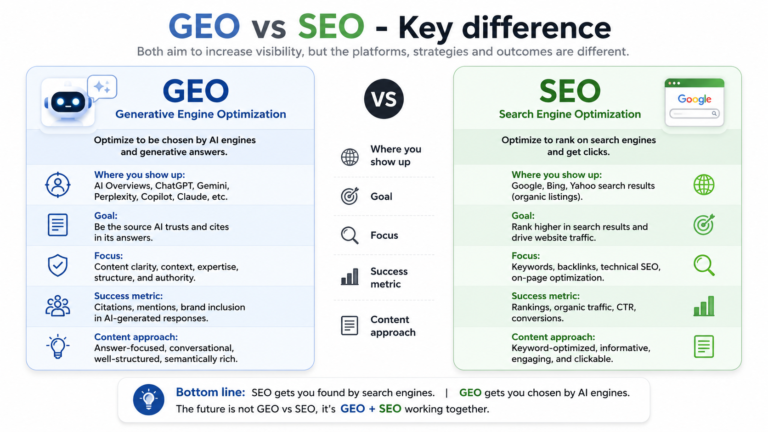
Generative engine optimization (GEO) is the work of getting your business cited, mentioned or recommended inside AI-generated answers, from ChatGPT, Perplexity, Google Gemini, Microsoft Copilot, Claude and Google AI Overviews. Where SEO earns a blue link, GEO earns a place in the answer itself.
GEO vs SEO vs AEO
| SEO | AEO | GEO | |
|---|---|---|---|
| Goal | Rank pages in search results | Be the direct answer in snippets and voice | Be cited or recommended in AI answers |
| Where | Google and Bing results | Featured snippets, People Also Ask, voice | ChatGPT, Perplexity, Gemini, AI Overviews, AI Mode |
| Main levers | Content, links, technical health | Question-shaped, structured answers | Entity clarity, third-party mentions, extractable content |
| Measured by | Rankings, clicks | Snippet ownership | Citations, share of voice, AI referrals |
They overlap heavily. Strong SEO is still the foundation, because AI tools retrieve from pages that already rank and earn trust.
How AI assistants choose which businesses to cite
- Retrieval: most AI search tools fetch live web pages (retrieval-augmented generation), often splitting your question into several related searches, a process known as query fan-out.
- Entity clarity: the model has to be sure who you are, what you do and where, from consistent data across your site, Google Business Profile, Wikidata and directories.
- Third-party agreement: brands that respected sites, reviews and communities such as Reddit mention repeatedly are named more confidently.
- Extractable content: clear definitions, comparisons, prices and FAQs are easier to quote than vague marketing copy.
Platforms I optimise for
ChatGPT (including ChatGPT search), Perplexity, Google AI Overviews and AI Mode, Google Gemini, Microsoft Copilot (powered by Bing) and Claude. Each draws on different sources, so the prompts that matter to your buyers are tested on each one separately.
Off-site authority that AI trusts
- Digital PR and expert commentary on respected publications.
- Accurate Wikidata, Google Business Profile and directory entries.
- Reviews and genuine community discussion, including Reddit and Quora.
- Brand mentions in comparison articles and “best of” lists in your category.
Measuring GEO when nobody clicks
- Prompt tracking: a fixed set of real buyer prompts tested monthly across each platform.
- Citation share of voice: how often you are named compared with competitors.
- AI referral traffic from chatgpt.com, perplexity.ai and others, segmented in GA4.
- Branded search growth in Google Search Console as AI mentions build awareness.
The technical side of GEO
AI crawlers such as GPTBot, OAI-SearchBot, PerplexityBot, ClaudeBot and Google-Extended need deliberate access rules in robots.txt. Server-rendered pages, Organization, Service and FAQ schema, and fast responses all make your content easier to retrieve. An llms.txt file is optional and experimental, so it is added only as a supplement, never as a substitute for the work above.
GEO Questions I Get Asked
01 What is Generative Engine Optimization (GEO)?
GEO is the practice of optimizing your online presence so AI systems like ChatGPT, Perplexity, and Google AI Overviews cite and recommend your business when answering relevant questions, as opposed to traditional SEO's focus on ranking in a list of blue links.
02 How is GEO different from traditional SEO?
SEO optimizes for ranking position in search results. GEO optimizes for being named directly inside an AI-generated answer, which depends more on entity clarity and third-party corroboration than on keyword targeting or backlink count alone.
03 How do you measure AI visibility?
By directly testing the real prompts your buyers use across ChatGPT, Perplexity, and Google AI Overviews every month, and tracking whether your business gets named, not by relying on a proxy metric or automated tool.
04 How long does GEO take to show results?
Most businesses see the first measurable citation gains in 8-12 weeks, since it depends on AI models re-indexing and re-training on updated sources, which takes longer than a typical search engine crawl.
05 Can you guarantee I'll be cited by ChatGPT?
No, and anyone who guarantees a specific AI model's output isn't being honest with you. What's guaranteed is a real, tested process, entity clarity, citations, and content structured for AI extraction, that measurably improves your odds.
06 Do I need GEO and SEO, or just one?
Both. AI Overviews and assistant answers still draw heavily from sources with solid traditional SEO, so GEO builds on top of technical and content SEO rather than replacing it.
07 How much does GEO cost?
It depends on how many AI platforms and prompts are tracked, your current brand mention footprint and the content work needed. You get a free audit within three working days, then a fixed written quote with no obligation. Starting prices for every service are listed on the pricing page.
08 How do ChatGPT, Gemini and Perplexity decide which brands to mention?
They retrieve web pages related to the question, then favour sources and brands that are clearly defined, consistently described and mentioned by trusted third parties. Clear, extractable content and strong off-site presence both raise your chances.
09 Can GEO help me appear in Google AI Overviews?
Yes. AI Overviews draw on pages that already rank well and answer the question clearly, so GEO combines solid SEO with content structured for extraction and stronger entity signals.
10 Do backlinks still matter for GEO?
Yes, as part of authority. Links and mentions from respected sites help pages rank and help AI systems trust your brand. Unlinked brand mentions count for GEO as well.
11 What role does schema markup play in GEO?
Schema states facts explicitly: who you are, what you offer, where and at what price. It reduces ambiguity for both search engines and AI systems, though it supports good content rather than replacing it.
12 Is SEO still relevant if I invest in GEO?
Very much. Most AI answers are built from pages that rank in search, so SEO remains the foundation. GEO adds the entity, citation and measurement work that rankings alone do not cover.