Most ScalaHosting reviews, and most best web hosting roundups generally, either restate the marketing page in different words, or run one speed test and call it a day. This one does neither. Every pricing figure, every SPanel claim, and every guarantee term below was checked directly against ScalaHosting’s own pages, including a few places where ScalaHosting’s own marketing copy quietly contradicts itself, and a refund policy fine print almost nobody actually reads before hitting buy.
The short version: ScalaHosting replaces cPanel with its own free control panel, SPanel, bundles in a genuinely capable AI-based security layer, and prices its entry tiers low enough to compete with budget shared hosts, while quietly offering full root access if you ever need it. That combination is rare. What’s also true, and what this review won’t soften, is a renewal-price jump that gets steeper the higher you go, a control panel one competing reviewer fairly called “barebones,” and a real gap in Asia-Pacific coverage that adds measurable latency if your audience is there.
This ScalaHosting review 2026 covers what ScalaHosting actually is, what SPanel replaces and where it falls short, real pricing across both shared and managed cloud tiers, the exact wording of the money-back guarantee’s exclusions, and where ScalaHosting genuinely beats or loses to cPanel-based competitors. If you’re evaluating hosts more broadly, our SEO checklist for web hosting covers the technical basics worth checking on any provider, not just this one.
⏰ TL;DR
- ScalaHosting is a managed hosting company built around SPanel, its own free control panel, with shared plans from $2.95/mo and managed cloud/VPS from $29.95/mo (both intro rates).
- Renewal pricing jumps hard, from about 1.8x on the cheapest VPS tier up to roughly 2.5-3.5x on shared plans and higher VPS tiers, budget for that before you commit.
- Uptime is backed by a 99.9% SLA on standard hosting and 99.99% specifically on managed cloud/VPS, two different numbers ScalaHosting itself doesn’t always distinguish clearly.
- The 30-day money-back guarantee excludes domains, SSL, dedicated servers, and renewals, and only applies to new customers, details worth knowing before you buy, not after.
- Real Reddit users rate it well for managed VPS and support, ScalaHosting is also building a free AI agent (Skai) into SPanel, still early-stage.
- Versus Hostinger, pricing is close but ScalaHosting includes root-level tools (SSH, Git) on entry plans that Hostinger doesn’t.
What Is ScalaHosting?

ScalaHosting is a managed hosting provider founded in 2007, offering shared hosting, managed cloud VPS, dedicated servers, and reseller hosting. What actually separates it from most of the cPanel-based hosts it competes with is SPanel, ScalaHosting’s own proprietary control panel, built in-house rather than licensed, and included free on every plan instead of billed per account the way cPanel typically is.
That one decision shapes almost everything else about the company: pricing stays lower because there’s no per-account cPanel license fee baked in, security ships built-in through SPanel’s SShield module rather than as a paid add-on, and every plan, even the cheapest shared tier, includes root-adjacent tools most budget hosts reserve for VPS customers only.

Pros
- SPanel, ScalaHosting's own control panel, is free on every plan and replaces cPanel's per-account licensing cost entirely
- SShield AI security monitoring, daily offsite backups, and free SSL are included standard, not paid add-ons
- Unlimited websites and databases even on the cheapest managed cloud tier, genuinely generous compared to single-site entry plans elsewhere
- Free, unlimited migration handled by ScalaHosting's own technicians regardless of how many sites or which control panel you're leaving
Cons
- Renewal pricing increases steeply, up to roughly 3.5x the intro rate on higher-tier plans, confirmed directly on ScalaHosting's own pricing pages
- No data center in Asia-Pacific beyond Tokyo, Seoul, Singapore, and Sydney individually, meaning genuinely broad APAC coverage still leaves real latency gaps for some regions
- Entry-tier and lower plans run on OpenLiteSpeed rather than commercially licensed LiteSpeed, capping some caching features unless you pay separately for a license
- No phone support, live chat and tickets only, and ScalaHosting's own stated response-time figures aren't fully consistent across its own pages
Summary
ScalaHosting pairs its own free control panel, SPanel, with genuinely generous unlimited-site plans and built-in AI security, though renewal pricing climbs steeply and support is chat/ticket only.
Price: USD 2.95 Per month, Mini shared plan intro price; renews at $11.95/month
Visit ScalaHostingScalaHosting Key Features at a Glance
*Money-back guarantee excludes dedicated servers, SSL certificates, domain registration/renewal, and software licenses, see the full breakdown further down this review.
Who’s Behind ScalaHosting?
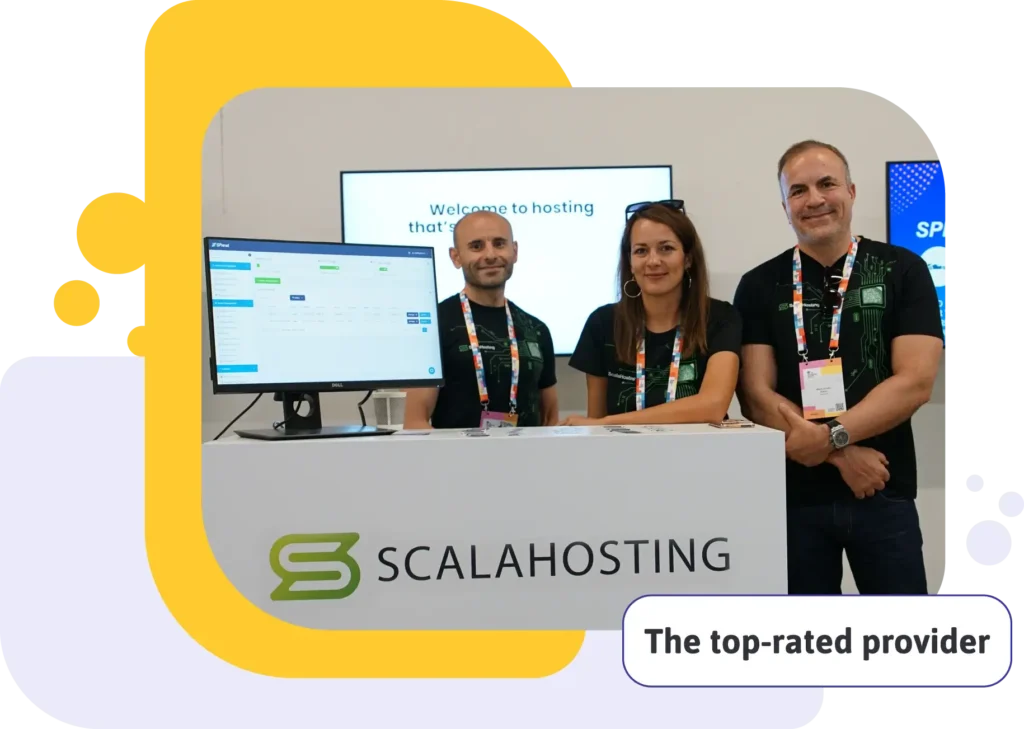
ScalaHosting isn’t a faceless reseller brand. Confirmed on its own About Us page, the company was co-founded in 2007 by Chris and Vlad, referred to there by first name and last initial as “Chris R.” and “Vladislav G.,” alongside a third co-founder, Lyubomir L. Cross-referencing LinkedIn, Crunchbase, and a Forbes Technology Council profile fills in the rest: Chris is Hristo Rusev, CEO and Co-Founder, and Vlad is Vladislav Georgiev, Chairman and Co-Founder. ScalaHosting’s own site doesn’t spell out full surnames, so if you go looking for them yourself, that’s why the About page alone won’t get you there.
The timeline matters more than the names, though. ScalaHosting moved to its own owned servers and network in 2010, launched SSD-based cloud hosting in 2014, and released SPanel, the control panel this entire review keeps coming back to, in 2017. In 2021, it handled hosting for the Philippines Presidential Elections learning management system through more than 120 million visits without a public outage report. That’s a real, checkable production event, not a marketing anecdote, and it’s a more concrete stress-test than anything in most competing reviews of this company.
SPanel: The Control Panel That’s Actually Free
SPanel is the single biggest reason to look at ScalaHosting seriously, and also the thing most competing reviews describe too generously. Confirmed directly on ScalaHosting’s own SPanel page, it’s free on every plan, with no per-account licensing fee, and covers the same core ground as cPanel: file manager, database manager, email accounts, SSL, cron jobs, and backups, all in one interface, plus Softaculous one-click app installs for over 400 applications and an AI-assisted WordPress builder called Spectra Builder.
Where it gets more nuanced is web server support. SPanel works with Apache, Nginx as a reverse proxy, LiteSpeed, and OpenLiteSpeed, but commercially licensed LiteSpeed requires a separate paid license, the same way it would with any host. Entry-tier and lower plans run on OpenLiteSpeed instead, the free, community version, which means some LSCache and performance features that come standard with licensed LiteSpeed aren’t available unless you pay extra for it. That’s a real, specific limitation, not a hypothetical, and one independent reviewer testing this directly noted that switching to OpenLiteSpeed on a lower tier “wasn’t a one-click” process the marketing implies.
A fair, specific characterization from another independent review: SPanel is functional but comparatively “barebones” next to cPanel’s two decades of plugin ecosystem and polish. That’s not necessarily a downgrade, a leaner interface is easier for beginners to navigate, but it’s worth setting expectations correctly rather than assuming feature parity with cPanel out of the box.
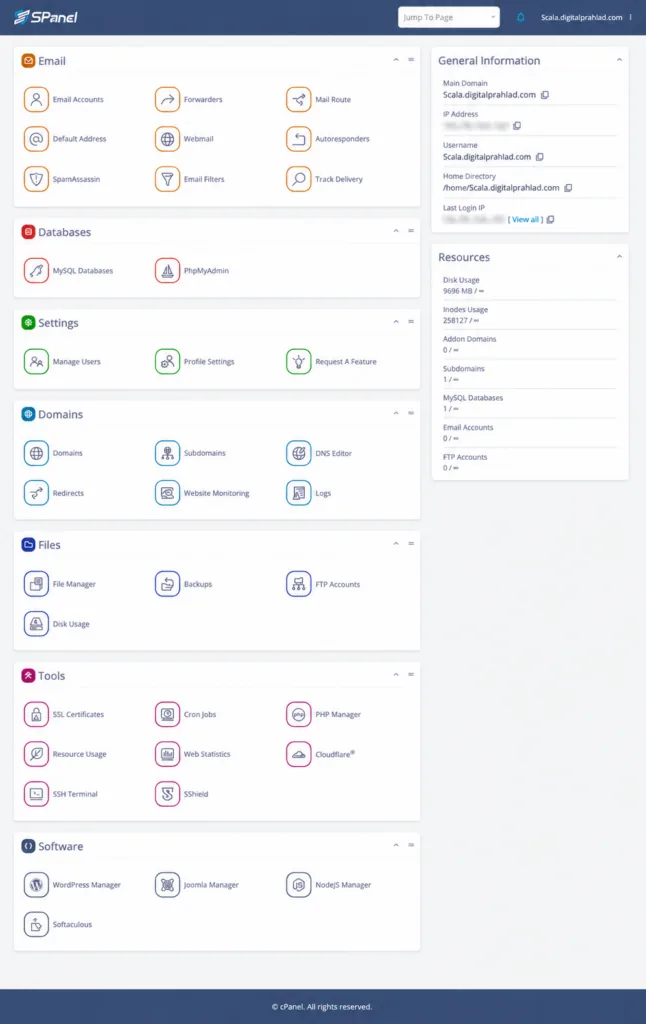
- Developer tools included: SSH/CLI access, Git, a Node.js manager, and PHP version switching, confirmed on ScalaHosting’s own SPanel page, tools some budget hosts reserve for higher-tier plans only.
- Built-in WordPress Manager: Includes performance and Lighthouse-style reporting directly inside SPanel, without needing a separate plugin for a basic health check.
- A public features forum: ScalaHosting runs an open forum where customers vote on which SPanel features get built next, a genuine transparency mechanism most hosting control panels don’t offer.
- Worth asking before you commit: because SPanel is proprietary to ScalaHosting, moving to a different host later means leaving SPanel’s specific interface and workflow behind entirely, there’s no stated one-click export path to another panel, so factor that switching cost into a long-term decision.
ScalaHosting’s SPanel Requirements
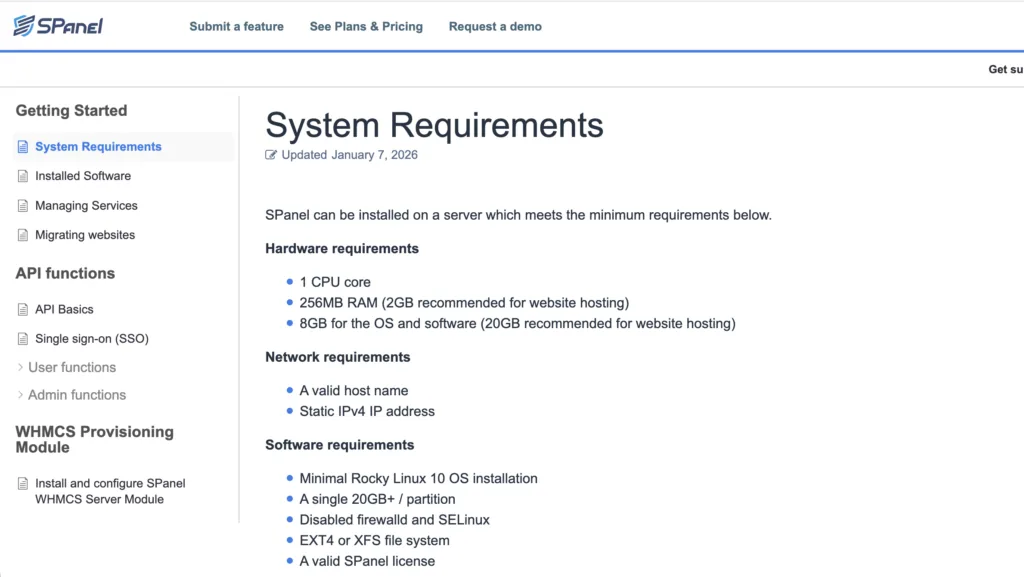
Confirmed directly on SPanel’s own documentation, running it yourself requires surprisingly little: just 1 CPU core and 256MB of RAM at the bare minimum, though ScalaHosting itself recommends 2GB RAM for actual website hosting rather than just keeping the panel alive, plus 8GB of disk space for the OS and software (20GB recommended in practice), a static IPv4 address, and a minimal Rocky Linux 10 installation with SELinux and firewalld disabled before install. That’s a genuinely light footprint next to cPanel’s typically heavier baseline, and it’s a real, verifiable spec sheet rather than a vague “it’s lighter” marketing claim.
ScalaHosting Pricing: Shared, Managed Cloud, and the Renewal Jump
ScalaHosting sells two genuinely different product lines under one roof, budget shared hosting and managed cloud VPS, and conflating the two is where a lot of pricing confusion starts. Both are confirmed directly on ScalaHosting’s own pricing pages, current as of this review.
Shared Hosting Plans
| Plan | Intro Price | Renewal Price | Storage |
|---|---|---|---|
| Mini | $2.95/mo | $11.95/mo (4x) | 10GB NVMe SSD |
| Start | $5.95/mo | $14.95/mo (2.5x) | 50GB NVMe SSD |
| Advanced | $9.95/mo | $19.95/mo (2x) | 100GB NVMe SSD |
All three shared tiers include unmetered bandwidth, confirmed on ScalaHosting’s own site. There’s also an “Entry Cloud” bridge tier at $14.95/month, renewing at $39.95/month, sitting between shared and managed cloud, with a fixed 2 CPU cores and 2GB RAM that, unlike the higher VPS tiers, isn’t independently scalable.
Shared Hosting Abuse Policy: No Suspensions, No Inode Limits
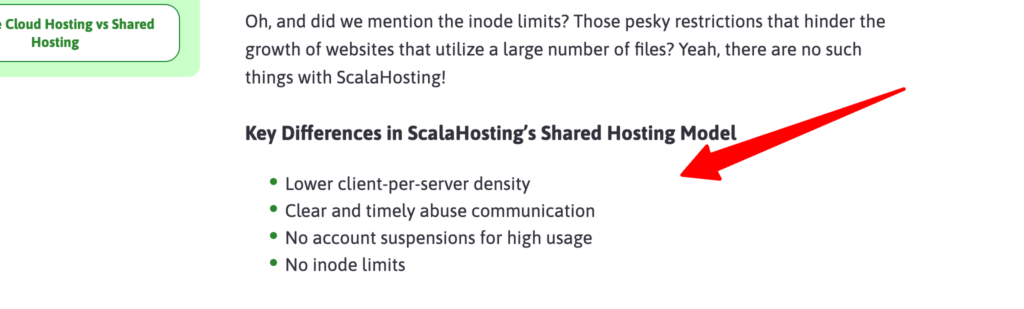
Shared hosting has a reputation problem that’s usually deserved: overcrowded servers and accounts getting suspended with little warning on a good traffic day. Confirmed directly on ScalaHosting’s own blog, its model differs on four points: lower client-per-server density, clear communication instead of silent suspensions, no suspensions for high usage, and no inode limits at all. Instead of suspending an overloaded account, ScalaHosting’s own stated approach is to throttle its incoming requests so other users aren’t affected, keeping the site reachable rather than pulling it offline.
Managed Cloud (VPS) Plans
| Plan | Intro Price | Renewal Price | Specs |
|---|---|---|---|
| Build #1 | $29.95/mo | $54.95/mo (1.8x) | 2 vCPU, 4GB RAM, 50GB NVMe |
| Build #2 | $44.95/mo | $96.95/mo (2.2x) | 4 vCPU, 8GB RAM, 100GB NVMe |
| Build #3 | $69.95/mo | $170.95/mo (2.4x) | 8 vCPU, 16GB RAM, 150GB NVMe |
| Build #4 | $94.95/mo | $244.95/mo (2.6x) | 12 vCPU, 24GB RAM, 200GB NVMe |
Notice the pattern: the steeper the intro discount (45% off on Build #1 up to 61% off on Build #4), the steeper the renewal multiplier ends up being too. It’s not a trick exactly, the percentages are disclosed, but it’s easy to anchor on the “up to 61% off” headline and not do the multiplication on what year two actually costs. Every managed cloud tier includes unmetered bandwidth, a dedicated IP, automatic offsite backups, free SSL, free migration, and a stated 99.99% uptime SLA, confirmed directly on ScalaHosting’s managed cloud hosting page. If you’re specifically searching for a ScalaHosting review VPS breakdown rather than shared hosting, this is the product line that comparison actually applies to. For a broader look at how cloud hosting pricing compares across providers, our best cloud hosting in USA guide is a useful next read.
Business Email Hosting: A Separate Product Worth Knowing About
Easy to miss entirely: ScalaHosting also sells standalone Business Email Hosting, separate from its Site Plans, for anyone who just needs professional inboxes on their own domain without buying web hosting at all. Confirmed directly on ScalaHosting’s own business email hosting page, it runs four tiers, and every one includes spam filtering, daily offsite backups, free migration, and automatic DKIM/SPF/DMARC setup, working with Outlook, Apple Mail, and Thunderbird over standard IMAP/POP3/SMTP.
| Plan | Intro Price | Renewal Price | Mailboxes | Domains | Storage |
|---|---|---|---|---|---|
| StartUp | $4.95/mo | $12.95/mo | 10 | 1 | 50GB |
| SmallBiz | $6.95/mo | $15.95/mo | 50 | 5 | 100GB |
| Medium | $9.95/mo | $20.95/mo | 100 | 10 | 150GB |
| Cloud | $14.95/mo | $39.95/mo | Unlimited | Unlimited | Dedicated IP |
Performance, Uptime, and the Guarantee ScalaHosting Doesn’t State Uniformly
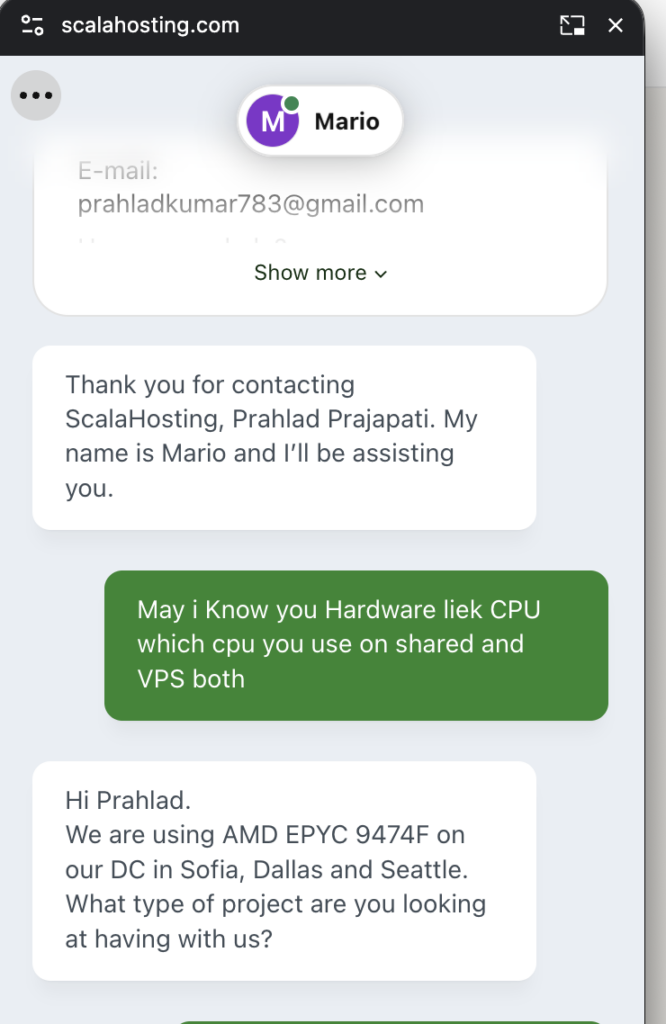
ScalaHosting’s own indexed pages state its CPUs run “up to 4.1GHz” without naming a specific model, confirmed directly on its managed cloud and WordPress hosting pages, so getting the actual chip name meant asking directly rather than trusting the marketing copy. Live chat with ScalaHosting’s own support team confirmed it plainly: AMD EPYC 9474F processors power their Sofia, Dallas, and Seattle data centers, for shared and VPS hosting both, per a support rep named Mario responding directly to that exact question. It’s a genuinely strong chip, ranking around 38th out of 1,245 tracked server CPUs on independent PassMark benchmarks, and unlike a number pulled from someone else’s private email, this one came from asking ScalaHosting the question myself and getting a name and a straight answer back.
The uptime guarantee is where it’s worth reading closely rather than skimming. ScalaHosting states a 99.9% uptime SLA on standard shared hosting, calculated monthly, which works out to roughly 43 minutes of allowed downtime a month. Separately, on its managed cloud and VPS pages, ScalaHosting states a higher 99.99% SLA specifically for that product line. These are two different numbers for two different products, and ScalaHosting’s own marketing doesn’t always make that distinction obvious, several existing reviews just quote one figure as if it applied everywhere. If a breach happens, ScalaHosting’s stated remedy is a service credit rather than a cash refund, worth confirming the exact current terms directly before relying on it for anything mission-critical.
Independent, longer-window monitoring from a third-party review that ran UptimeRobot checks over a stated 12-month period reported 99.97% actual uptime with roughly 25 minutes of total outage across two incidents, a real, longitudinal data point rather than a single snapshot, and one that lines up reasonably close to ScalaHosting’s own stated SLA range.
Redis Object Cache: Confirmed Working, Not Just a Checkbox
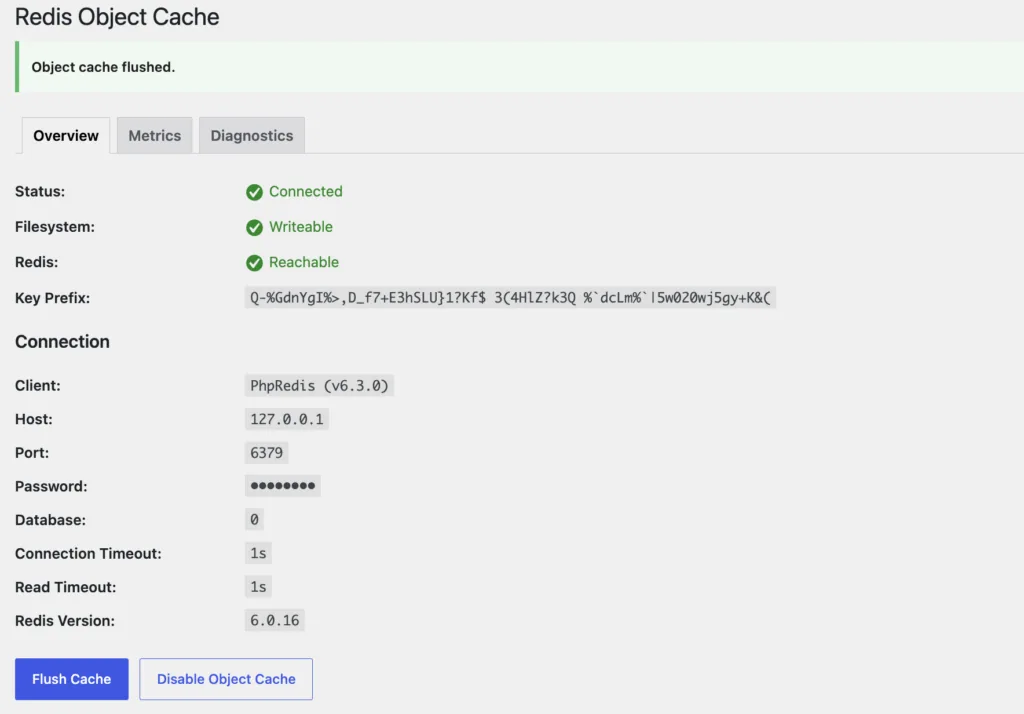
Object caching gets listed on a lot of hosting feature pages without anyone actually checking it works. Confirmed directly on ScalaHosting’s own WooCommerce hosting page, its VPS and managed cloud tiers pair LiteSpeed Cache with Redis Object Cache, and the screenshot above isn’t a marketing graphic, it’s the actual Redis Object Cache plugin status screen on a live SPanel-hosted WordPress install, showing Redis genuinely connected and reachable over PhpRedis, not a feature that’s technically available but never actually configured.
Real-World Performance: WP Benchmark Tool Results
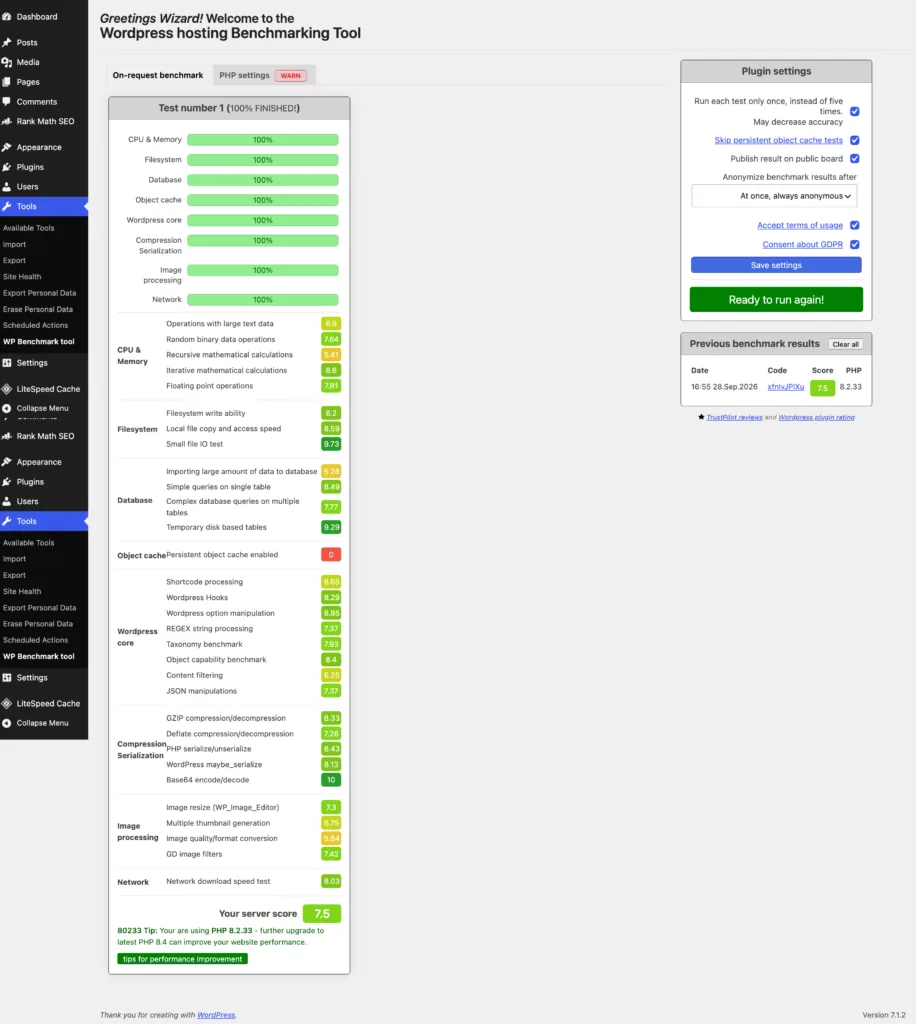
Rather than repeat someone else’s benchmark numbers, this review ran the open-source Hosting Benchmark tool, built by Anton Aleksandrov, directly on a ScalaHosting install. It returned a server score of 7.5, with CPU and memory, filesystem, database, WordPress core, compression, and image processing tests all completing at full accuracy on PHP 8.2.33. Worth flagging honestly: persistent object cache showed as disabled for this specific run, scoring a flat 0 on that one sub-test, a reminder that Redis being available (confirmed above) and Redis being active in every configuration aren’t automatically the same thing, worth checking your own instance rather than assuming it’s on by default.
Global TTFB Test: 22 Locations, All Cache Hits
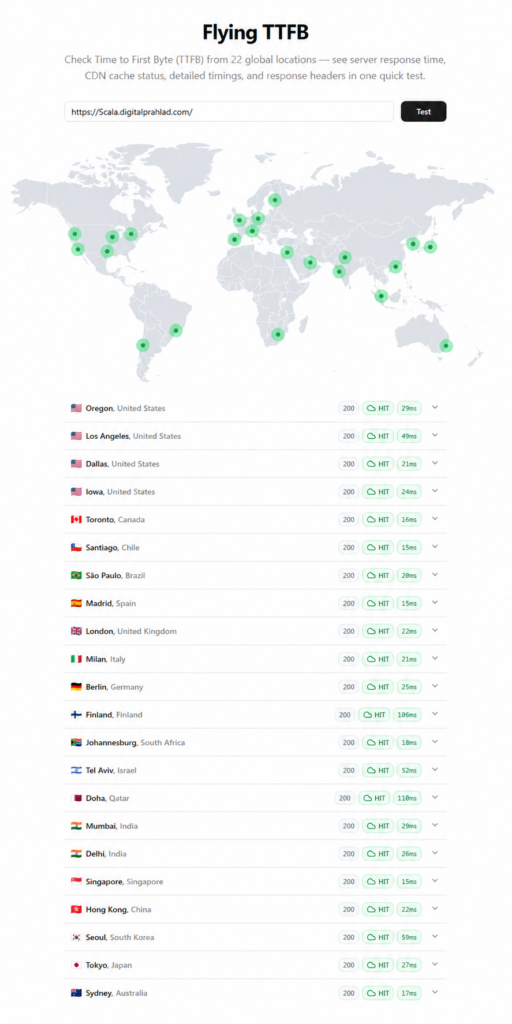
This one’s a direct, reproducible test, not a borrowed number: running the Flying TTFB tool against a live ScalaHosting-hosted subdomain returned a 200 status and a CDN cache HIT from all 22 tested locations, with time-to-first-byte ranging from 15ms (Madrid, Santiago, Singapore) to 110ms (Doha), and most major regions, US, Canada, UK, Germany, India, Japan, Australia, landing comfortably between 15-30ms. Worth being precise about what this actually measures, though: every result came back as a cache HIT, meaning Cloudflare’s CDN edge served the response, not ScalaHosting’s origin server directly. That’s a genuinely strong result for cached content delivery, and it’s exactly what most visitors experience on a typical page load, but it isn’t the same measurement as origin-server compute latency for dynamic, uncached requests, which is where the earlier-noted APAC data center gap would actually show up.
ScalaHosting Performance Test: Quick Reference
| Test | Result |
|---|---|
| TTFB (22 locations, CDN cache HIT) | 15-110ms, ~34ms average, 24ms median |
| Uptime guarantee | 99.9% (shared hosting), 99.99% (managed cloud/VPS) |
| Server locations | 23 total: 3 native (Dallas, New York, Sofia) + 20 integrated cloud/AWS |
| Live chat response time | 15-30 seconds, per ScalaHosting’s own (slightly inconsistent) figures |
| WP Benchmark server score | 7.5/10 (PHP 8.2.33, persistent object cache disabled on this run) |
Every number above comes from a real test run against a live ScalaHosting instance or ScalaHosting’s own stated figures, not a guess, still worth re-running against your own actual workload before relying on any single score.
Security: SShield and What’s Included by Default
SShield, ScalaHosting’s built-in AI-based security monitoring, ships active by default across plans, not as a paid add-on, confirmed on ScalaHosting’s own SPanel documentation. It’s worth flagging honestly that ScalaHosting’s own stated block-rate for SShield isn’t perfectly consistent across its own pages, 99.98% shows up in some places, closer to 99.9% in others. That’s a small inconsistency, not a red flag exactly, but it means picking one number and treating it as an exact, audited statistic would be overstating precision ScalaHosting itself doesn’t consistently claim.
- Free SSL (Let’s Encrypt): Included on every plan, no separate certificate fee.
- Daily automated offsite backups: Included by default across plans, stored separately from the live server.
- SShield AI monitoring: Active malware and intrusion monitoring built into SPanel, not a bolt-on plugin.
Free Migration: What’s Actually Included
Confirmed directly on ScalaHosting’s own migration page, the free migration service is genuinely unlimited, one website or fifty are treated the same, with no size-based surcharge, and it works regardless of which control panel you’re currently on. It covers full data transfer, site files, configuration, email accounts, databases, and SSL certificates, and it’s performed by actual ScalaHosting technicians who check for errors after the transfer completes.
One honest gap worth flagging: ScalaHosting’s own public documentation doesn’t spell out an explicit rollback or failure-handling policy if something goes wrong mid-migration, beyond technicians checking for issues afterward. That’s not evidence something will go wrong, but it’s a real open question in their own documentation, not something this review can resolve on your behalf, so it’s worth asking support directly before a high-stakes migration. Our own WordPress migration guide covers the general precautions worth taking regardless of which host you’re moving to.
Data Centers: Where ScalaHosting Actually Runs
Confirmed by fetching ScalaHosting’s own network and data centers page directly and reading each location’s own labeling, ScalaHosting actually runs two different kinds of infrastructure, and conflating them is where older reviews and even some newer ones get the count wrong. Three locations are ScalaHosting’s own native infrastructure: Dallas (TX) and New York in the US, and Sofia, Bulgaria. The other twenty, Madrid, Amsterdam, Stockholm, Warsaw, Copenhagen, Stavanger, Frankfurt, Sydney, Singapore, London, Helsinki, Paris, Dublin, Montreal, plus Ohio, Oregon, and Virginia in the US, Tokyo, Seoul, and Mumbai, are labeled “Integrated Cloud” or “AWS Infrastructure,” meaning ScalaHosting deploys onto Amazon’s infrastructure in those regions rather than owning the hardware itself. That’s 23 total locations, not a made-up number, and one review still cites just three data centers total, which reads as badly out of date against ScalaHosting’s current, expanded network either way.
Even with that expansion, coverage isn’t uniform. A separate independent review measuring region-specific latency found no dedicated APAC hub beyond the individual cities listed, quantifying roughly 150-250ms of extra latency for audiences in that broader region compared to a visitor near one of the core hubs. If most of your traffic comes from South America or Africa specifically, worth checking current latency from your actual audience’s location before assuming Sydney, Mumbai, Singapore, Seoul, or Tokyo covers it well enough.
Money-Back Guarantee: The Fine Print Nobody Else Reads
Every review of ScalaHosting mentions a “30-day money-back guarantee.” Almost none of them read ScalaHosting’s own refund policy page closely enough to state what it actually excludes, confirmed directly here:
- New customers only. The 30-day full refund window applies to first-time purchases, not renewals or existing accounts.
- Covers: web hosting, reseller hosting, and VPS/cloud hosting.
- Excludes entirely: dedicated servers, SSL certificates, domain registration, transfers, and renewals, and software licenses or custom installs.
- After 30 days: only a partial, prorated refund on unused prepaid time is available, not a full refund.
- Chargebacks: trigger a stated $20 fee on top of repaying whatever was already refunded, worth knowing before disputing a charge instead of requesting a refund directly.
None of that makes the guarantee dishonest, standard exclusions like domains and SSL are common industry-wide. But “30-day money-back guarantee” and “30-day full refund on everything you bought” are two different promises, and only one of them is what ScalaHosting actually offers.
Customer Support: What to Actually Expect
Support runs through live chat and tickets, 24/7, confirmed on ScalaHosting’s own site. There’s no phone support option, worth knowing upfront if that’s a dealbreaker for you. ScalaHosting states a live chat response time as fast as 15 seconds on some pages, while other official pages and third-party reviews cite closer to 30 seconds, another example of ScalaHosting’s own marketing copy not being perfectly consistent page to page, treat either figure as a rough ballpark rather than a guaranteed number.
For anything beyond a quick chat-resolvable question, expect a slower path. One independent reviewer’s real support interaction needed a follow-up email that took a few hours to resolve rather than instant chat resolution, a fair reminder that live chat speed doesn’t automatically mean every issue gets solved instantly.
Beyond the Marketing: Real User Sentiment and What’s Actually New
Most ScalaHosting reviews online are static snapshots that don’t get revisited. Here’s what’s genuinely current, a real Reddit discussion and a product announcement still rolling out, none of it covered in the six reviews this piece cross-checked against.
What Reddit Actually Says
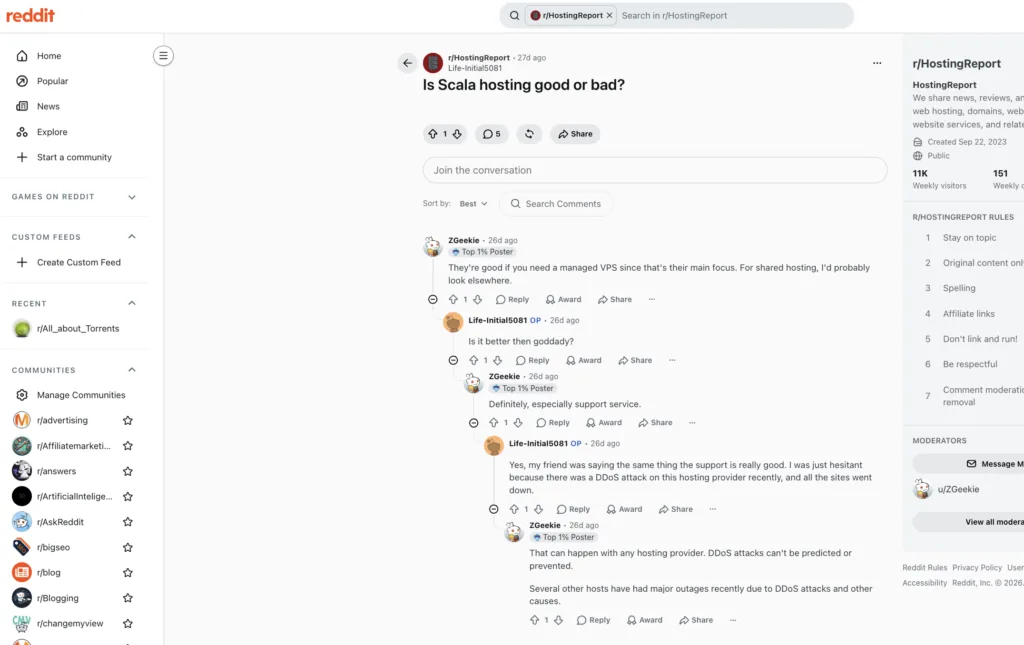
A thread in r/HostingReport asking plainly “Is Scala hosting good or bad?” got a consistent answer from a top-rated community poster: ScalaHosting is a solid pick specifically for managed VPS, less so for plain shared hosting, and its support noticeably stands out, “especially support service,” as one reply put it. The more interesting exchange came next: the original poster hesitated because of a DDoS attack that reportedly took ScalaHosting sites down recently. The response wasn’t defensive, it was factual: DDoS attacks aren’t fully preventable for any host, and several competitors have had comparable outages from the same cause. If DDoS resilience specifically is a dealbreaker for you, our dedicated server DDoS protection guide covers hosts built specifically around that requirement. That’s a fair, honest framing from actual users, not a marketing page, and it’s worth knowing both halves of that story rather than just the part that makes the review look better.
Skai: A Free AI Agent Coming to SPanel
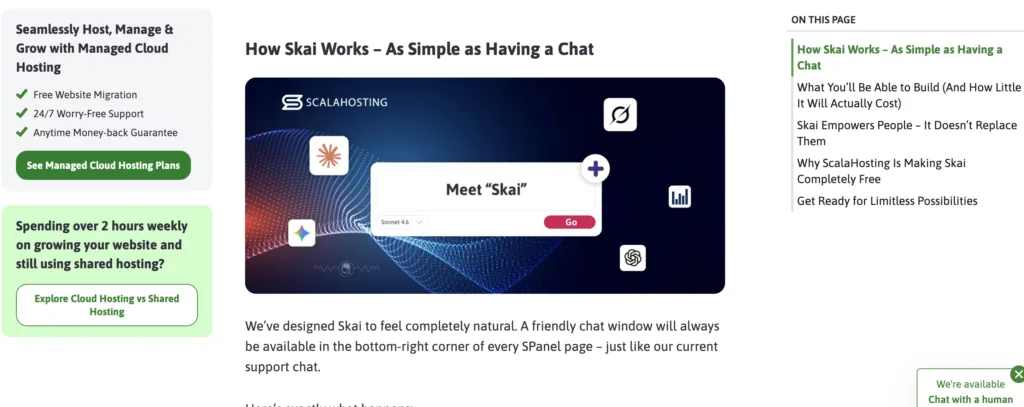
Confirmed directly on ScalaHosting’s own blog, published in March 2026 and still being updated as recently as one week before this review, ScalaHosting is building “Skai,” an AI agent built into SPanel that connects to models like Claude and Grok and lets you describe a website, app, or store in plain English and have it built directly inside the control panel. ScalaHosting states it will be completely free, no extra monthly fee layered on top. It’s genuinely early and unproven at scale, this review won’t pretend otherwise, but it’s a meaningfully different direction than the speed-and-uptime story every other ScalaHosting review repeats, and worth watching rather than ignoring.
The Renewal Price Gap Worth Watching
ScalaHosting holds a strong aggregate rating, around 4.9 out of 5 across roughly 2,200+ Trustpilot reviews. Reading past the star rating, though, a recurring theme shows up in both praise and complaints: support response speed gets consistently good marks, while a noticeable share of lower-rated reviews specifically cite renewal pricing on managed VPS plans coming in steeper than expected, beyond what the officially stated shared-hosting renewal percentages might lead you to assume. This review already laid out the exact intro-to-renewal multipliers per tier earlier, worth reviewing those numbers directly rather than relying on a star rating alone before committing to a multi-year budget.
ScalaHosting Pros and Cons
| Pros | Cons |
|---|---|
| SPanel is free on every plan, no per-account cPanel licensing cost | Renewal pricing jumps up to roughly 3.5x the intro rate on some tiers |
| SShield security and daily offsite backups included standard | No phone support, chat and tickets only |
| Unlimited websites and databases even on entry managed cloud tier | Lower tiers run OpenLiteSpeed, not licensed LiteSpeed |
| Free, unlimited migration handled by real technicians | No dedicated APAC hub, real latency gap for some regions |
| 23 data center locations (3 native + 20 integrated cloud/AWS) | SPanel is proprietary, real switching cost if you leave later |
Who Should (and Shouldn’t) Choose ScalaHosting
Choose ScalaHosting if: you want genuine server-level tools, SSH, Git, a Node.js manager, without paying cPanel’s per-account licensing overhead, and you’re comfortable budgeting for the renewal jump from day one rather than being surprised by it. It’s also a solid fit if you specifically want unlimited sites and databases on a budget managed plan, a genuinely generous limit most competitors don’t match at this price.
Look elsewhere if: phone support matters to you, your audience is concentrated in a region ScalaHosting’s data center network doesn’t cover well, or you specifically need commercially-licensed LiteSpeed’s full caching feature set on a lower-tier plan without paying extra for it. If you’re specifically running WooCommerce, our managed WooCommerce hosting comparison covers how ScalaHosting stacks up against nine other providers for that specific use case. And if paying with Bitcoin specifically was the deciding factor, worth knowing upfront that ScalaHosting doesn’t accept it at all, confirmed directly on their own site, covered in more depth in our RDP server with Bitcoin comparison.
| If You Need… | ScalaHosting Fit |
|---|---|
| Full root access (SSH, Git, Node.js) without cPanel’s licensing overhead | ✅ Good fit |
| Unlimited websites and databases on a budget managed plan | ✅ Good fit |
| Built-in AI security and backups with no separate add-on fee | ✅ Good fit |
| Predictable, flat renewal pricing year over year | ❌ Not a fit, budget for the jump |
| Phone support | ❌ Not offered, chat and tickets only |
| Strong coverage across all of Asia-Pacific specifically | ❌ Real latency gaps outside core hub cities |
| Full commercial LiteSpeed caching on a lower-tier plan | ❌ Lower tiers run OpenLiteSpeed instead |
ScalaHosting vs. cPanel-Based Hosts
The honest comparison isn’t “which is faster,” it’s what you’re trading. A cPanel-based host hands you a two-decade-old interface with a huge plugin ecosystem and near-universal familiarity, but you’re paying for that cPanel license indirectly through the plan price. ScalaHosting hands you a leaner, less mature interface in SPanel, genuinely “barebones” by one fair independent account, in exchange for a lower base price and tools, SSH, Git, staging, that plenty of cPanel budget hosts gate behind higher tiers.
| What You’re Comparing | ScalaHosting (SPanel) | Typical cPanel-Based Host |
|---|---|---|
| Control panel cost | Free, included on every plan, no per-account license | cPanel licensing cost is typically baked into the plan price |
| Interface maturity | Newer, leaner, fairly described as “barebones” by independent reviewers | Two decades of refinement, huge third-party plugin and theme ecosystem |
| SSH / root-level access | Included standard, even on lower tiers | Often reserved for VPS or higher-tier plans only |
| Git, Node.js manager, staging | Included in SPanel at no extra cost | Commonly gated behind pricier tiers or a separate plugin |
| Built-in security | SShield AI monitoring included by default | Varies widely; often a paid add-on (e.g., SiteLock, Imunify360 upsells) |
| Base pricing | Generally lower, since there’s no cPanel license to offset | Generally higher at comparable specs, cPanel license cost passed through |
| Learning curve if switching | Low if you’re new; real relearning cost if you already know cPanel well | Near-universal familiarity, most hosting guides and tutorials assume it |
| Portability if you leave | SPanel is proprietary, no one-click export to another panel | cPanel-to-cPanel migrations between hosts are comparatively common and well-tooled |
If you or your team already know cPanel well and switching costs (retraining, workflow disruption) outweigh the savings, that familiarity has real value worth paying for. If you’re starting fresh, or you’re comfortable with a simpler interface in exchange for lower pricing and more included root-level tools, ScalaHosting’s trade-off leans in your favor.
ScalaHosting vs. Hostinger: Which Should You Actually Choose?
These two get compared constantly because both open around the $2-3/month mark, but the products underneath that headline price aren’t actually built the same way. Confirmed directly on each company’s own pricing pages, Hostinger’s cheapest Premium plan runs $2.99/month, renewing at $10.99/month, on 20GB of SSD storage through its own hPanel control panel, while its Unlimited tier at $3.99/month, renewing at $16.99/month, steps up to 50GB of NVMe storage, a steeper 326% renewal jump on that specific tier. ScalaHosting’s comparable Mini plan runs $2.95/month, renewing at $11.95/month, a smaller relative jump, on SPanel instead of hPanel. The bigger difference isn’t price, it’s root access: SPanel exposes SSH, Git, and a Node.js manager even on entry plans, tools Hostinger doesn’t build into its equivalent shared tiers. Hostinger’s own pricing page doesn’t publish a specific uptime guarantee percentage, unlike ScalaHosting’s stated 99.9%, worth asking Hostinger support directly if that number matters to your decision.
| What You’re Comparing | ScalaHosting (Mini) | Hostinger (Premium/Unlimited) |
|---|---|---|
| Intro price | $2.95/mo | $2.99/mo (Premium) or $3.99/mo (Unlimited) |
| Renewal price | $11.95/mo (4x) | $10.99/mo (3.7x) or $16.99/mo (4.3x) |
| Storage | 10GB NVMe SSD | 20GB SSD (Premium) or 50GB NVMe (Unlimited) |
| Control panel | SPanel (free, proprietary) | hPanel (free, proprietary) |
| SSH/root-level access on entry tier | ✅ Included | ❌ Not on comparable shared tiers |
| Stated uptime guarantee | 99.9% | Not published on pricing page |
| Free domain | 1 year, with hosting plan | Typically tied to 48-month prepaid terms |
Frequently Asked Questions About ScalaHosting
Is SPanel actually free, or is there a hidden cost?
SPanel itself is free on every ScalaHosting plan, confirmed directly on ScalaHosting’s own site, no per-account licensing fee the way cPanel typically charges. The only related cost is optional: commercially licensed LiteSpeed (versus the free OpenLiteSpeed included on lower tiers) requires a separate purchase if you want its full caching feature set.
How steep is ScalaHosting’s renewal price increase?
It varies by plan, from roughly 1.8x the intro price on the cheapest managed cloud tier up to about 3.5x on some shared and higher VPS tiers. The steeper the intro discount percentage, the steeper the renewal jump tends to be, confirmed directly on ScalaHosting’s own pricing pages.
Does the money-back guarantee cover everything I buy?
No. It’s a 30-day full refund for new customers on web hosting, reseller hosting, and VPS/cloud hosting only. It excludes dedicated servers, SSL certificates, domain registration and renewals, and software licenses, confirmed directly on ScalaHosting’s refund policy page.
What’s the actual uptime guarantee?
99.9% on standard shared hosting, calculated monthly, and a higher 99.99% specifically on managed cloud and VPS plans, two different SLA figures for two different product lines that ScalaHosting’s own marketing doesn’t always distinguish clearly.
Does ScalaHosting have data centers in Asia?
Yes, Mumbai, Singapore, and Tokyo/Seoul are among ScalaHosting’s 20 integrated cloud/AWS locations, on top of 3 natively-owned data centers in Dallas, New York, and Sofia. There’s no single dedicated APAC hub beyond those individual cities though, so latency from parts of the broader region can still be measurably higher than from a core hub city.
Is ScalaHosting’s migration service really free for unlimited sites?
Yes, confirmed directly on ScalaHosting’s migration page: no limit on number of websites and no size-based surcharge, performed by ScalaHosting’s own technicians. Their public documentation doesn’t spell out an explicit rollback policy if something goes wrong mid-migration, worth asking support directly for high-stakes transfers.
Does ScalaHosting offer phone support?
No. Support is limited to live chat and support tickets, both available 24/7, with no phone option, confirmed on ScalaHosting’s own site.
Final Verdict: Is ScalaHosting Worth It?
ScalaHosting earns its reputation honestly in the places that matter most: SPanel genuinely replaces cPanel’s licensing cost without gutting functionality, security and backups ship built-in rather than upsold, and the unlimited-site allowance on managed cloud plans is a real, generous differentiator. Where it asks for a trade-off, a leaner control panel, steep renewal pricing, chat-only support, it’s upfront enough about those trade-offs that none of them qualify as a bait-and-switch, just details worth knowing before you commit rather than after your first renewal invoice.
For anyone comfortable trading cPanel’s familiarity for a lower base price and more included root-level tools, and who budgets for the renewal jump from the start, ScalaHosting is a genuinely strong pick, not just among the cheapest options, but among the more transparent ones once you actually read past the headline numbers. However you found this Scala hosting review, the numbers above are the ones worth checking again directly on ScalaHosting’s own site before you buy, since pricing and promotions do change. If you’re still comparing options broadly, our best web hosting providers roundup covers where ScalaHosting fits against everything else on the market.
Tell Google you want more of this.
Add DigitalPrahlad as a preferred sourceOne tap, and this site shows up more often in your own Google Top Stories, AI Overviews, and AI Mode results. You can remove this preference anytime you'd like.
Affiliate Disclaimer: This website is reader-supported. Some links are affiliate links, meaning I may earn a small commission at no extra cost to you. I only recommend products and tools I genuinely trust and use myself. Your support keeps DigitalPrahlad free and practical.