Schema Markup Services That Win You Rich Results
Validated JSON-LD schema that states your facts explicitly, Organization, Product, FAQ, Review, so Google and AI engines extract them directly instead of inferring from prose.

Schema Markup Services for Every Type That Applies
Organization Schema
The core facts about your business, name, logo, contact details, and social profiles, stated explicitly for Google and AI models alike.
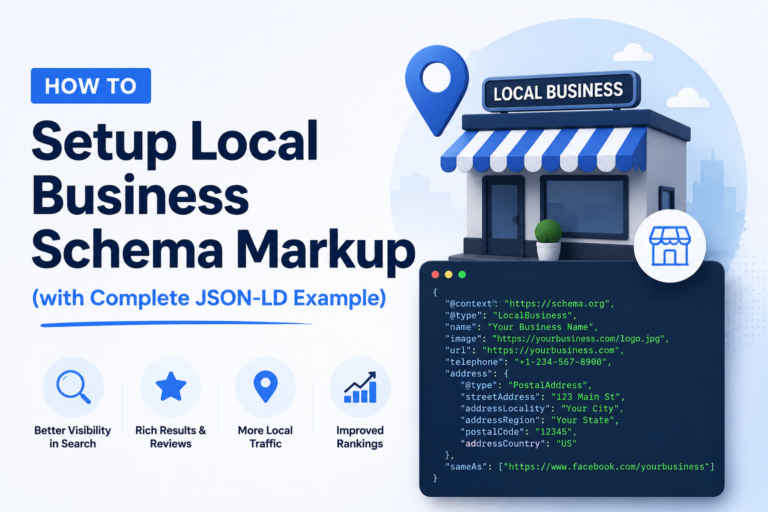
LocalBusiness Schema
Hours, location, and service area stated explicitly, so Google doesn't have to guess at facts you already know.
Article & BlogPosting Schema
Author, publish date, and headline marked up correctly, since missing or wrong article schema is a common cause of lost rich results.
Product Schema
Price, availability, and ratings marked up so products are eligible for rich result listings in search.
FAQ Schema
Question-and-answer content marked up explicitly, exactly the format AI models prefer to quote directly.
Review & AggregateRating Schema
Genuine review data marked up correctly, never fabricated ratings, which risks a manual action from Google.
BreadcrumbList Schema
Clear site hierarchy markup that also improves how your URLs display directly in search results.
Service Schema
What you offer, to whom, and where, stated explicitly for service-based businesses instead of buried in page copy.
Event Schema
Dates, location, and ticketing details marked up so events are eligible for rich result listings.
Person & Author Schema
Real author credentials marked up explicitly, reinforcing the E-E-A-T signals Google and AI models both weigh.
Schema Validation & Error Fixing
Checking existing schema for validation errors and warnings that are silently causing rich results to be dropped.
Ongoing Schema Monitoring
Catching schema that breaks silently after a theme or plugin update, before it costs you rich results.
One Fixed Price for the Full Implementation
Schema markup is a fixed-fee project, scoped to exactly which schema types your site actually needs, not a generic one-size package.
Every schema type is validated before delivery, not just checked for syntax.
How I Implement Schema Markup
No generic plugin-generated schema dropped in blind. Every type is scoped to what your site actually has and validated before launch. The goal isn't passing a validator. It's Google and AI models actually extracting the right facts.
The goal isn't passing a validator. It's Google and AI models actually extracting the right facts.
Checking any schema already on the site for validation errors, and identifying which types are genuinely missing.
Deciding exactly which schema types actually apply to your site and content, not implementing every type by default.
Writing and implementing JSON-LD, checked against Google's Rich Results Test before anything goes live.
Confirming schema renders correctly in Search Console and stays valid after launch.
What I Actually Use, and Why
Google Rich Results Test
Google's own tool for confirming a schema type is eligible for a rich result, checked before anything ships.
Google Search Console
To confirm schema is actually being read correctly at scale and catch enhancement errors after launch.
Schema.org Validator
Checking markup against the official Schema.org vocabulary, not just Google's subset of supported types.
Is Schema Markup Actually What You Need?
Good fit
- Search Console is showing schema validation errors or warnings you haven’t addressed
- You have FAQ, review, or product data that isn’t currently marked up at all
- A previous developer or plugin implemented schema that’s now broken or outdated
- You want AI models to extract accurate facts about your business directly
- Competitors are showing rich results in search that you currently aren’t
Not the right fit yet
- Your site has serious technical or content problems that need fixing first
- You’re looking for guaranteed rich results, Google alone decides whether to display them
- You want fabricated review ratings or fake data marked up, that risks a manual penalty
- Your site has no real content or facts yet for schema to actually describe
Schema guide
Schema Markup and Structured Data, Explained
How structured data works, what it can and cannot do, and how it is implemented so it keeps working after launch.
How schema markup works
Schema markup is code, written in the Schema.org vocabulary, that labels the facts on a page: this is a business, this is its address, this is a product with this price and rating. Search engines read it to qualify pages for rich results and to connect your brand to the right entity in Google’s Knowledge Graph. AI systems use the same signals to describe you accurately.
What schema can and cannot do
- It can make pages eligible for rich results such as review stars, product prices, breadcrumbs and event dates.
- It can remove ambiguity about who you are, using @id, sameAs links and consistent Organization data.
- It cannot guarantee a rich result. Google decides whether to show one, and some types (such as FAQ and HowTo rich results) now appear only for limited sites.
- It cannot rescue thin content. It describes good pages; it does not replace them.
JSON-LD vs microdata vs RDFa
Google supports all three, but recommends JSON-LD: a separate script block that does not tangle with your HTML, is easy to maintain and survives theme changes. Old microdata from themes and plugins is a common source of duplicate or conflicting schema, so it is cleaned up during the audit.
Platforms: plugins vs custom schema
WordPress plugins such as Rank Math and Yoast add basic schema automatically, and Shopify themes add product markup. These defaults are a starting point, but they often duplicate entities, miss properties or mark up the wrong page type. Custom JSON-LD fills those gaps on WordPress, WooCommerce, Shopify, Next.js and custom builds, working alongside the plugin rather than fighting it.
Schema at scale: e-commerce and multi-location
Product catalogues need Product and Offer markup generated from your data, so prices and stock stay accurate on thousands of pages. Multi-location businesses need a LocalBusiness entity per branch, linked back to one parent Organization. Both are built as templates, not hand-written page by page.
Validation and monitoring after launch
Every type is tested in Google’s Rich Results Test and the Schema.org validator before launch. After launch, the enhancement reports in Google Search Console show errors and warnings as Google recrawls, so theme updates or plugin changes that break markup get caught early.
Schema Markup Questions I Get Asked
01 What is schema markup?
Schema markup is structured data, usually written as JSON-LD, that states facts about your content explicitly, like a product's price or an article's author, so search engines and AI models can extract them directly instead of inferring from prose.
02 Does schema markup guarantee a rich result in Google?
No, valid schema makes you eligible for a rich result, but Google decides whether to actually display one. The goal is removing every technical reason it wouldn't, not guaranteeing it will.
03 Can you fix schema errors from a previous developer or plugin?
Yes, an existing schema audit is included with every project, catching validation errors and outdated markup left behind by a previous implementation.
04 Which schema types does my site actually need?
That depends entirely on your content and business type. The audit determines exactly which types genuinely apply, implementing every possible type by default just adds unnecessary complexity.
05 How does schema markup help with AI visibility?
AI models rely on structured data to extract accurate facts about your business, product, or content. Explicit schema makes you a more reliable, easily-cited source than a page an AI has to infer facts from.
06 Is it safe to mark up reviews with schema?
Yes, as long as the reviews are genuine. Marking up fabricated or incentivized reviews as if they were organic violates Google's guidelines and risks a manual action.
07 How much does schema markup cost?
It depends on the number of page templates and schema types, your CMS and any existing markup that needs fixing. You get a free audit within three working days, then a fixed written quote with no obligation. Starting prices for every service are listed on the pricing page.
08 Do you work with WordPress, Shopify or custom-built sites?
Yes. WordPress and WooCommerce, Shopify, Next.js and custom builds are all supported, with JSON-LD added through templates so it stays maintainable.
09 Is schema a one-time job or does it need maintenance?
Implementation is one project, but schema can break when themes, plugins or templates change. Search Console monitoring is available as an add-on to catch that early.
10 Can incorrect structured data hurt my SEO?
Errors usually just stop rich results from showing. Misleading markup, such as fake reviews, can lead to a manual action, which is why every property is checked against what the page actually shows.
11 How long before Google picks up new schema?
Google usually processes new markup within days to a few weeks, as pages are recrawled. Search Console enhancement reports confirm when it has been read.
12 Is custom schema better than a plugin like Yoast or Rank Math?
Plugins cover the basics well. Custom JSON-LD adds the types and properties plugins miss and fixes duplicates, so the best result usually combines both.
13 Can you add schema for many locations or a large product catalogue?
Yes. Product, Offer and LocalBusiness markup is generated from templates and your data, so it scales to thousands of pages and stays accurate.